
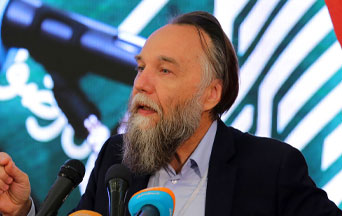
Photo: © Fars Media Corporation, CC BY 4.0
For a long time, I have tried to read the work of Alexander Dugin, the guru philosopher of Vladimir Putin. Many acclaim his criticism of the modern liberal world and applaud his proposed solutions. They say he is the key to understanding Russia today.
However, my efforts were not successful. Instead of clarity, I found his material to be rambling, esoteric and confusing. Despite many attempts, I could not make sense of much of what he said.
Thus, it was with some surprise, and even relief, that I discovered an article in the February 2023 print edition of First Things titled “Alexander Dugin Explained.” Finally, someone offered to explain his thought, and I eagerly took up the task of reading the article.
A Qualified Opinion
The author, Michael Millerman, is qualified to talk about Dugin. The Russian’s insights so transfixed him that he co-translated Dugin’s 2009 masterwork, The Fourth Political Way, into English. Thus, his long article succinctly outlines some critical aspects of Dugin’s thought.
However, his narrative only increased my misgivings about Dugin. After reading the article, I do not share the author’s cautious yet positive opinions about his theories. His explanations did not make the esoteric concepts any clearer. Millerman does help readers understand the present drama unfolding in Ukraine.
The Fourth Political Theory
That is not to say that everything inside Duginism is convoluted and mysterious. Millerman’s article outlines some things that are easily grasped.
For example, Dugin’s key thesis, which he calls “the fourth political theory,” is not hard to understand. Dugin observes that the twentieth century was dominated by three ideological political currents—liberalism, Communism and Fascism. By the end of the century, Communism and Fascism were defeated, and liberalism triumphed alone as a single pole of thought.
Eternal and Natural Law: The Foundation of Morals and Law
Dugin believes that this triumph makes it difficult to criticize the crisis inside modern liberalism. Thus, those who legitimately oppose liberalism are often accused of being either communists or fascists, supposedly making resistance impossible.
I take issue with this assumption. A vast amount of scholarship, much of it Catholic, has opposed liberalism inside the bosom of liberal society for two hundred years. See, for example, Pope Gregory XVI’s encyclical Mirari vos of Aug. 15, 1832, and “The Syllabus of Errors” by Pope Pius IX (1864). Even today, the debate rages on as liberalism is crumbling, and people are searching for solutions.
This false assumption, however, prepares the way for Dugin’s fourth political theory. He claims to break through the problem of criticizing liberalism by providing an intellectual space to explore new possibilities outside the three old frameworks. He sees this as a never-before-seen discovery, a kind of political sliced bread worthy of provoking much “dancing and rejoicing.”
A Multipolar World
This fourth political theory presents a different paradigm for those who want to challenge decadent and globalized liberalism.
Inside this fourth political theory, the different peoples create civilizations, forming large civilizational spaces and blocs. Smaller nation-states enjoy the semblance of sovereignty under the umbrella of “politically organized, militarily capable civilizational centers that represent the poles of a multipolar world.”
This multipolar model is very well represented in the Ukrainian conflict. Putin seeks to return Ukraine to the Russian civilizational space despite the population’s wishes to the contrary.
Targeting Liberalism
Another clear notion is that Dugin’s thought and his fourth political way target liberalism for many of the same reasons those who defend tradition oppose it. Indeed, liberalism tends to erode institutions, foster materialism and favor atomistic individualism. This liberalism paved the way for decadent postmodernity, which is generating ever-more monstrous forms of political and cultural expression.
 Learn All About the Prophecies of Our Lady of Good Success About Our Times
For this reason, the Dugin proposal attacks the “woke” world that questions identity, imposes gender ideology and promotes critical race theory. Thus, Dugin’s ideas are mistakenly identified as a classical conservative project because he targets these aberrations. However, he would be the first to admit that he does not share the same philosophy.
This outlook gives rise to a fundamental problem with Duginism. His attack on liberalism includes everything Western and Catholic. He does not see modern liberalism as a parasite on Western Christian thought and Aristotelian metaphysics but a consequence. It must be replaced by many paradigms (including Islamic ones) that are entirely different and non-Western.
The Heidegger Connection
Up to this point, Dugin’s thought can at least be grasped. However, Millerman’s entry into the philosophical roots of Duginism plunges everything into esoteric darkness. He says that the key to understanding Dugin can be found in the Russian’s interpretation of Martin Heidegger. This affirmation explains much of the rambling and mystery in my first encounters with Dugin.
Indeed, Martin Heidegger (1889-1976) is a very awkward person to use as a foundation. His 1927 book, Being and Time, startled the German philosophical world with its complexity. The Encyclopedia Britannica makes a telltale commentary about the book, saying, “Although almost unreadable, it was immediately felt to be of prime importance.”
The German philosopher was a consummate rambler and leading exponent of existentialism and phenomenology that formed the basis of anti-liberal postmodern thought. He drew heavily upon Søren Kierkegaard and Friedrich Nietzsche. He was also a supporter of Adolf Hitler.
10 Razones Por las Cuales el “Matrimonio” Homosexual es Dañino y tiene que Ser Desaprobado
He was imprisoned after the war because of his clear Nazi connections. However, his reputation does not seem to have suffered from the links. His supporters on the left and right find no difficulty in citing him.
And so, if you want to understand Dugin, Heidegger is your man. However, he is not mine.
A Revolution, Not a Modification
I understand enough of Heidegger to know that it is not worthwhile to delve deeply into the shallow lake of his muddled thought. I prefer to leave him “unreadable” and avoid his existential fog.
What he proposes is not a modification of how we see the world but a revolution that overturns the metaphysical foundations of the Christian West. His is a purely philosophical proposal in which Christianity plays, at best, a secondary role.
“We know from texts published in Heidegger’s lifetime,” writes Notre Dame Prof. Cyril O’Regan, “that he thinks that Christianity constitutively represses free inquiry; that ‘Christian philosophy’ is in essence an oxymoron; that Christian thought is straight-jacketed by a commitment to explanation and specifically to the construction of a First Cause.”
Suffice it to say that Millerman tells how Dugin, channeling Heidegger, calls upon us “to turn our thoughts from the mainstream metaphysical tradition, which talks of being and beings, toward the source of the thought-worthy as such.”
Inside the esoteric ramblings of modern philosophies are the pagan overtones of errors long conquered by the Church. The eternal questioning of the essence of being can lead to pantheism and mysticism.
Science Confirms: Angels Took the House of Our Lady of Nazareth to Loreto
Millerman exults in “a kind of intellectual renaissance on the right” that includes controversial figures like Friedrich Nietzsche and Carl Schmitt, “who had been appropriated by the left after World War II” and now find “a more natural place on the political spectrum.” Figures like Islamist thinker René Guénon and occultist Julius Evola are also receiving attention. Millerman puts Dugin’s Heidegger-driven political theory into this intellectual context,
This collection of intellectuals, most of them hostile to God, is not the stuff from which a Catholic revival will come.
What Is to Be Sought
This is the time to return to Christendom’s philosophical and metaphysical roots, not to look elsewhere. We must reject the esoteric chaos of postmodernity and adopt the crystalline logic, accessible to all, of Church teaching. This foundation gave rise to an organic Christian society bound by God’s law and suited to human nature. It produced real intellectuals like the Scholastics and Saint Thomas Aquinas, which these intellectuals despise.
In his encyclical Immortale Dei (1885), Pope Leo XIII described this resultant order as one in which “the influence of Christian wisdom and its divine virtue permeated the laws, institutions, and customs of the peoples, all categories and all relations of civil society.”
To combat the errors of liberalism, the Church has the answer. Catholic thinker Prof. Plinio Corrêa de Oliveira affirms that the Christian civilization is a solution that can fill the postmodern void. We must seek a society that is “austere and hierarchical, fundamentally sacral, anti-egalitarian and anti-liberal.”