
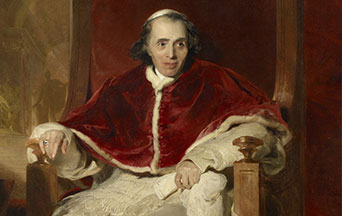
On July 6, 1808, by Napoleon’s orders, French soldiers arrested Pius VII. They took the Pontiff to Savona, a Ligurian city near Genoa. The Papal Secretary of State Cardinal Bartholomeo Pacca, detained on the same occasion, was imprisoned in the Fenestrelle Fortress, near Turin, roughly eighty-five miles from Savona. Napoleon’s motive was obvious: to isolate the Pope from his associates, thereby preventing him from fulfilling his Papal duties.
Soon after the invasion of the papal palace, posters appeared on Rome’s walls announcing the Emperor’s excommunication to the people. Despite intense measures taken by the imperial police, the news of the Pope’s imprisonment and the text of the excommunication bull quickly spread across Italy and even into France, including Paris. The speed with which the news spread suggests the existence of a well-oiled organization, ensuring the transmission of news and documents in Italy and France.
In fact, throughout his captivity, Pius VII received the documents he needed and communicated with cardinals and his closest aides, despite Napoleon’s attempts to stop him. However, the French police were alert, constantly working to isolate the Pope. What was this organization that helped him communicate with others? This historical problem—a bit like a detective novel—is slowly being unraveled by historians.
Eternal and Natural Law: The Foundation of Morals and Law
Those wishing to know this organization better encounter great difficulties. One is the existence of seemingly contradictory testimonies written by participants in these events. Until recently, most of these documents were kept in family archives, only becoming public when historians located them. On the one hand, the contradictions between several documents tend to confuse historians. On the other hand, despite these issues, they do shed more light on events. They unveil some of the activities of these Catholic associations that joined forces to fight for the Pope against the Emperor. Today, one can say that Aa, the Marian Sodalities of France, and Father Pio Brunone Lanteri’s Amicizie were the primary associations that made up that network. The Marian Sodalities of Lyon and Paris were the most active. As we have seen, the one in Lyon was and remained secret until its members dissolved it. Although not acting together, the Paris organization provided the network’s most prominent leaders.
In his book Histoire Secrète de la Congrégation de Lyon, Antoine Lestra describes some of the Lyon sodality leaders’ early contacts with their more prominent Parisian counterparts.
“Mathieu de Montmorency, a Paris sodality member, was the first one received as an associate of Lyon’s Sodality, in which he consecrated himself on July 15, 1804. On November 1, he was followed by Alexis de Noailles; on December 8, by Louis Auguste de Rohan Chabot, future Cardinal Archbishop of Besançon; on July 21, 1805, by Charles de Forbin-Janson, later Bishop of Nancy and founder of the Association of the Holy Childhood. The date of entry of the two Montmorency-Laval brothers is missing.”
Duke Mathieu de Montmorency was the soul of the Paris Sodality. A descendant of the first Baron of France, his social position and personal gifts naturally recommended him as the leader of the French sodality members. Several times, he served as prefect of his sodality and later Grand Master of the Knights of the Faith, a secret Order of Chivalry we will study in the future.
 Learn All About the Prophecies of Our Lady of Good Success About Our Times
Marquis Eugène de Montmorency-Laval, Count Alexis de Noailles, Marquis Charles de Forbin-Janson, and the Duke de Rohan Chabot were at his side. They were still laymen when they joined the Paris Sodality and, later, the one in Lyon. Adrien de Montmorency-Laval is the other Montmorency-Laval mentioned by Antoine Lestra. Many other Paris Sodality members were of the highest nobility. All participated in these struggles and showed great courage and combativeness. In 1807, Franchet d’Esperey and Berthaud du Coin, prefect and first assistant of the Lyon Sodality, were received into the Paris Sodality to make the collaboration between the two organizations closer.
The two most flourishing sodalities in France thus united. That union was not merely spiritual. They joined forces to carry on a secret apostolate. This work became increasingly necessary as Napoleon’s threats to intimidate the Pope expanded.
The Lyon Sodality founders had been active in Father Jacques Linsolas’ so-called underground Church. The members knew how to wage an organized fight against the Revolution. Each was fully aware of the absolute necessity of maintaining the strictest secrecy. Furthermore, they had learned from experience the dangers of being deceived by seeming appeasement. (Let us recall what happened to Father Linsolas. When Napoleon started negotiations with the Holy See to restore worship in France, many “underground Church” people assumed the religious persecution was over. The members began to work in the open, which allowed the police to discover their entire organization and arrest Father Linsolas.) Antoine Lestra’s book describes the sodality’s leadership role, especially in the planning phases.
After being received into this sodality, Count Alexis de Noailles and the Marquis de Forbin-Janson rented an apartment in Lyon. They frequented assiduously the salon of Berthaud du Coin’s mother, where the city’s Catholic elite gathered. Mathieu de Montmorency also went to Lyon often and stayed at a hotel. The resistance formed through their constant contacts.
10 Razones Por las Cuales el “Matrimonio” Homosexual es Dañino y tiene que Ser Desaprobado
Antoine Lestra tells us there was a poor elderly woman in town whose family name was Martin. She spent her days sitting in an armchair, suffering her ailments with great resignation. She was very pious. Many Catholic leaders visited her humble home because they greatly appreciated her spiritual conversation. In her house, Benoit Coste and Lyon Sodality leaders met with Duke Mathieu de Montmorency, Count Alexis de Noailles, and other visitors. The available evidence indicates that this was where they forged plans for future collaboration. This poor woman’s home was ideal for such meetings. The police hardly suspected counter-revolutionary activities in what looked like the pious meetings of a material charity.
Precisely what the Sodality planned is unknown. However, as a result, we see emissaries traveling through various cities in France and Italy. They contacted people best known as counter-revolutionaries, strengthening bonds of friendship and cooperation between their associations and others already participating in resistance operations.
Father Pierre Joseph Rey was one of the most ardent members of Chambéry’s Aa. He was received as an associate member of the Lyon Sodality on the same day as Mathieu de Montmorency. In a previous article, we wrote about him and his friendship with Venerable Pio Brunone Lanteri. He directed the Chambéry Society of Friends and probably spoke with Father Lanteri and won the support of Italy’s various Amicizie for the resistance.
Many other associations cooperated with Lyon’s Sodality. Unfortunately, we cannot yet draw a picture of all those who made up this communications network between Savona and Paris. It was, nonetheless, powerful. Not even Napoleon’s Minister of Police, Joseph Fouché, could destroy it. The Pope’s arrest signalled the beginning of organized Catholic resistance. Releasing the bull announcing the Emperor’s excommunication was only the first excellent service counter-revolutionary Catholics rendered the Church during Napoleon’s reign.