
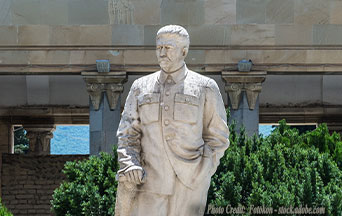
During Vladimir Putin’s time at the Kremlin, over 100 statues of Stalin were erected throughout the Russian Federation. At the same time, BBC reports, many of the over 700 plaques commemorating Stalin’s victims have been removed. A sculpture commemorating Stalin was installed last May in the Taganskaya subway station in Moscow. It duplicates one installed there in 1950 and removed in 1961.
The sculpture’s reception is mixed. Subway riders have laid hundreds of red carnations at the Stalin figure’s feet. In this act, some see nostalgia for the “glory days” of Communism. Others see the flowers as symbols of the blood Stalin shed.
The Irish Star printed the anguish of one anti-Stalinist.
Why America Must Reject Isolationism and Its Dangers
“For the current government, the main thing is the state. The state is sacred, the state is above everything, the state is infallible,” expressed Yan Rachinsky, a human rights advocate dedicated to revealing Stalin’s atrocities at the Moscow office of Memorial [a group dedicated to memorializing Stalin’s victims]. “That is why criticism of Stalin is constantly decreasing.”
De-Stalinization and Restoration
Indeed, Stalin’s life confirms Mr. Rachinsky’s assessment. The horrors of the Gulags, Lubyanka Prison, the measures taken to collectivize agriculture, periodic purges of his deputies and generals, and Stalin’s deliberate abandonment of the people of Stalingrad provide only a starting point. The state-engineered “Great Famine of 1932-33” alone caused the deaths of an estimated four million people in Ukraine.
Such were the massacres during Stalin’s reign that not even the communists could continue his legacy. During the early sixties, Nikita Khrushchev initiated a program called “De-Stalinization” to rid the nation of Stalin’s influence and denounce his excessive atrocities. That effort lost steam during the Brezhnev era, but Gorbachev resumed it. By the time the Soviet Union disintegrated in late 1991, Stalin was a dim memory for a rapidly aging few.
Nonetheless, Putin is now rehabilitating Stalin to a figure of national acclaim. It fits in with the anti-Western philosophies of ideologues like Alexander Dugin, who see him in a nationalist light.
Truth Becomes a Misdemeanor
Perhaps the dimness of memories allows for a revision of history to fuel these nationalist and anti-Western sentiments. Anyone who contests this reading can face prosecution.
For example, according to the Associated Press (AP), a Russian citizen was fined 300,000 rubles for posting on social media that “the Communists and Germany attacked Poland together, unleashing World War II.” He was convicted of breaking a 2014 law against “rehabilitating Nazism.” Rehabilitating Stalin is apparently off the books.
The Alliance of Dictators
The man’s message was undoubtedly accurate. The historical record is clear. On August 22, 1939, Adolf Hitler’s foreign minister, Joachim Ribbentrop, flew to Moscow to meet with his Soviet counterpart, Vyacheslav Molotov. Over the next three days, they hammered out an agreement. The U.S.S.R. would stand aside as Germany invaded Poland. In return, Germany would raise no objections to Soviet occupation of the eastern half of Poland, as well as Estonia, Latvia and Lithuania. Germany invaded Poland the following week, beginning the European phase of World War II.
Eternal and Natural Law: The Foundation of Morals and Law
This infamous pact would not stand the test of time. On June 22, 1941, Hitler invaded the Soviet Union, and Stalin became an ally with the major “capitalist” powers of the time. Only with massive military aid from the U.S. (which the new Russian history books deny) did the Soviets manage to survive. However, Statin immediately turned upon the West after the war.
Recasting History
The return of Stalin’s statues across Russia is an ominous sign. If a universally recognized dictator responsible for the death of millions is lionized, then these same acts might be repeated. Those who refuse to learn from history’s mistakes are often condemned to repeat them.
It is no wonder that the Ukrainians are fighting so hard for their freedom. They at least remember the fabricated famines, the Gulags and the annihilation of the Catholic Church in their land. They also see Stalin statues rise in the present occupied territories.
To those Ukrainians who know their history and suffered under Stalin’s rule, this fight is a life or death fight for country and Faith.
Photo Credit: © Fotokon – stock.adobe.com