
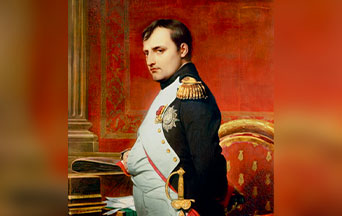
Napoleon arrested Pope Pius VII on July 6, 1808. This extraordinary event triggered the alliance formed by the Marian Sodalities of Paris and Lyon, the Amicizie, and other lesser-known associations. Immediately, the alliance started using its contact networks, especially in France and Italy. These associations successfully made public essential documents concerning relations between Napoleon and the Holy See, as well as the emperor’s excommunication. Their need to work in the strictest secrecy still obscures the record of how they distributed these documents throughout France and Italy. At this point, it is only possible to relate these matters in general terms.
One example of how documents were spread is told by Geoffroy de Grandmaison. In his 1889 book La Congrégation, which had great repercussions, he reveals in a few lines how the emperor’s bull of excommunication arrived in Paris:
“The excommunication bull was received in Lyon by Franchet d’Esperey and Berthaud du Coin and brought to Paris by Marquis Eugène de Montmorency, who hid a copy in his boots to frustrate the police search. This episode was traditional knowledge in the Montmorency Family, and Count Charles de Maistre, a nephew of Marquis Eugène, communicated it to Grandmaison.”
Eternal and Natural Law: The Foundation of Morals and Law
An important book by Father Guillaume de Bertier de Sauvigny1, Le Comte Ferdinand de Bertier et l’énigme de la Congrégation, shed new light on the Paris Sodality, especially on its action against the imperial police. Later, Father Candido Bona, with his book Le Amicizie,2 More recently, Antoine Lestra’s Histoire secrète de la Congrégation de Lyon (1967) clarified several remaining doubts, making possible a more detailed account of this heroic resistance.
Based on these works and an article by Father Verriest published in 1960 in the Revue d’Histoire Ecclésiastique, we will try to summarize this admirable page in the history of the Church.
Cardinal Bartholomeo Pacca, the papal Secretary of State, prepared several documents to be published if Napoleon went to the last extremes against the Holy See. Antoine Lestra lists the following:
1. The Bull Quum Memoranda, which excommunicated Napoleon. This 45-page text was too long to announce the excommunication quickly and efficiently;
2. A book-length manuscript containing official documents by Napoleon and the Holy See about the events that culminated in the pope’s arrest. It had no commentary and started with these words: “We invoke all that is most sacred in Religion to guarantee the authenticity of the documents about to be read.” This manuscript was titled Correspondance authentique de la Cour de Rome avec la France depuis l’invasion de l’État romain jusqu’à l’enlèvement du Souverain Pontife [Authentic correspondence of the Court of Rome with France from the invasion of the Roman State to the kidnapping of the Sovereign Pontiff];
 Read About the Prophecies of Our Lady of Good Success About Our Times
3. Three concise documents dated June 10, 11, and 12, 1809, suitable to be reproduced on posters and posted on city walls:
a) a protest against Rome’s occupation: “Under unworthy pretexts, and with the greatest injustice, We are deprived of temporal sovereignty, to which Our spiritual independence is closely linked.”
b) a note on the excommunication: “Pius VII to the Emperor of the French: By the authority of Almighty God, by that of the Holy Apostles Peter and Paul, and by Our own, We declare that you and all your collaborators have incurred excommunication after the attack you have just made. … We also declare excommunicated all those who have been leaders, authors, advisers, and anyone who has cooperated in the execution of these attacks or committed them;”
c) a decree that reads, “In the name of the Holy Trinity, Father, Son and Holy Spirit, and of the Apostles Peter and Paul, Pius VII, servant of the servants of God, to all the faithful who read this, Apostolic greeting and blessing.
“Forced to use the authority the heavenly Father has granted Us to govern the Church, We declare in this document which We have written, signed, and sealed with the Fisherman’s ring, that Napoleon I, Emperor of the French, and all his adherents, supporters and counselors, have incurred the excommunication We threatened earlier (particularly in Our first protest of April 5, 1809) because of his decree of May 17 ordering the invasion of the city of Rome.
“We declare that all those who oppose the publication of this declaration by force or any other means incur ipso facto the same excommunication. Also included in it are all members of Our Apostolic College, bishops, prelates, whether secular or regular, who, for whatever reason or human respect, refuse to conform to what We have decreed with the assistance of the Father of lights, in Our decrees of the 10th and 11th of June. Given at Our Quirinal Palace on June 12, in the 1809th year of the Birth of Our Lord Jesus Christ, and the tenth of Our Pontificate. Pius PP. VII.”
10 Razones Por las Cuales el “Matrimonio” Homosexual es Dañino y tiene que Ser Desaprobado
These last three documents appeared on Rome’s walls at dawn the day after the pope’s arrest. Napoleon’s accomplices were unable to prevent the spread of the news of their master’s excommunication.
After being in prison for a while, Cardinal Pacca was questioned about the publication date of a book in four small volumes that the police had seized. The cardinal replied that the work was released on June 10, 1809, immediately following the arrest. It was a limited edition containing the pope’s correspondence with the French government from 1806 until the invasion of Rome, published on the orders of Pius VII. The manuscript mentioned under no. 2 above, released later, contained that correspondence and more material related to the time following the invasion. The full text of the Bull Quum Memoranda was unknown until later.
These June 10, 11, and 12 documents spread elsewhere in Italy and abroad. They reached the hands of sodality members and Christian Friends. The whole apparatus of the Lyon Sodality was activated to disseminate them.
Updated September 2, 2025.
Footnotes
- Guillaume de Bertier de Sauvigny (1812-2004) was a French priest, historian and professor at the Catholic Institute of Paris. His specialty was the Restoration period of 1814-1830. He was a descendant of Count Ferdinand de Bertier.
- Fr. Candido Bona, Le Amicizie-Società Segrete e Rinascita Religiosa (Friendships, Secret Societies and Religious Revival), 1962. Published in Italian, not translated into English.