
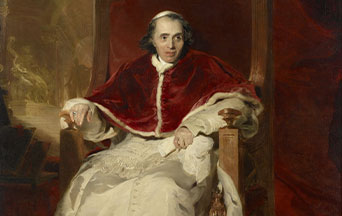
Napoleon’s ambitions were boundless. However, he knew that he needed to base his strategies on political reality. Before he assumed the title of Emperor in 1804, he was aware that French public opinion was eager to see Napoleon establish relations between France and the Holy See, which the radicalism of the French Revolution had disrupted. Therefore, Napoleon was eager to sign the 1801 Concordat. All the while, Napoleon always remembered that his goal was to use the Church to speed the spread of revolutionary errors worldwide.
When he saw that a weak Pius VII systematically made concessions to him, Napoleon worked to subordinate the Church to the State, albeit gradually. He planned to transfer the Holy See to Paris. Once established in the French capital, the Papacy would be nothing more than a docile Ministry, answerable only to the Revolution’s Emperor. Indeed, such a move would make the Church entirely dependent on him.
Therefore, Napoleon was surprised by the Pope’s reaction when France occupied the Papal States in 1809. In his mind, these events forced Napoleon to precipitate events and have Pius arrested. The Emperor was confident that this coup de force would intimidate Pius VII. Seeking to soften the reaction of Catholic opinion, Napoleon pretended to be annoyed by the episode. He sought an opportunity to apologize without compromising his reputation. He stated that his subordinates had misinterpreted his orders and that he had not ordered the arrest of the Pope. At any rate, he kept the Pope imprisoned and did not give up his plan to transfer the Church’s government to Paris.
After some hesitation about the fate of his august prisoner, Napoleon had Pius brought temporarily to Savona and installed in its episcopal palace. One factor in Napoleon’s choice of location was that the Count of Chabrol, the Prefect of the Department, was an engaging and pleasant conversationalist. The Emperor believed that the Count could help to convince Pius VII to move to Paris.
Napoleon issued orders to facilitate that goal. He instructed his brother-in-law and the Governor of French Piedmont, Prince Camillo Borghese: “One must spare nothing that can contribute to this old man’s well-being and comfort. I don’t want him to have the impression of being imprisoned. The guard around him must look like a guard of honor.”
At first, the Pope enjoyed relative freedom in Savona. The French-dominated government called his closest aides to keep him company. This included the domestic staff who served him in Rome. His Holiness could receive visitors, stroll through the city, and converse with people who approached him. Those who served him also benefited from these concessions.
However, the Pope’s household was strictly supervised. Count de Chabrol visited him daily, trying to win his friendship so that he could better fulfill the mission Napoleon had entrusted to him. It was all in vain. The Pope quickly realized that he could not govern the Church freely. Accordingly, Pius VII refused any further concessions and rejected the pension the French government offered him. Returning to his old Benedictine habit, he retired to his quarters and began living like a monk.
Amicizia Cristiana was the first association in the underground network organized by the Sodality of Lyon to contact the papal Prisoner in Savona. Naturally, the proximity of Turin (roughly 100 miles) facilitated this approach. Father Pio Brunone Lanteri was always ready to act when an opportunity presented itself. He organized a committee whose first step was to obtain funds to support the Pope so he would not be economically dependent on Napoleon. With the collaboration of two bankers, Nigra and Gonella, he raised significant contributions. Father Lanteri brought these to the pontiff on different occasions. The first consignment appears to have been made by an Amicizia member, Chevalier Cesare Renato Galleani d’Agliano. Circumventing the vigilance of the French police and paving the way for future meetings, Father Lanteri delivered it directly to the Pope.
Cardinal Pacca found himself in a more difficult situation. Napoleon viewed Pius VII’s Secretary of State as the primary obstacle hindering the Holy See’s relocation to Paris. The French sent him to Fenestrelle with chains around his neck. This famous fortress in the Alps was situated at the highest point of the border between France and Italy. It consisted of two forts linked together by a staircase of four thousand steps and protected by various military defenses. One of these forts, St. Charles, was the place Napoleon sent the most dangerous Italian political prisoners. Amid eternal snows and strong icy winds, living conditions at Fenestrelle were extremely harsh. Since opportunities to escape were minimal, prisoners were treated with some liberality. Occasionally, they even received visitors who stayed overnight in the fort. Of course, all such visitations happened under strict police surveillance.
Cardinal Pacca, however, was isolated at St. Charles in a room he could not leave. He was forbidden to contact any prisoners and subjected to all kinds of harassment. Only his chamberlain could speak to him. Only with difficulty did the Cardinal obtain a Bible and some books to read. In his memoirs, he recounted an episode revealing the strict surveillance to which the guards subjected him. Upon his arrival, he asked for a confessor. Although many priests were imprisoned in the fort, the imperial government systematically refused his request. He wrote:
“After waiting during October, November, and part of December, I asked my chamberlain to arrange with Father Sebastiano Leonardi for a secret visit to my room on Christmas Eve so I could go to confession. Father Leonardi hid in the corridor. When he saw the sentry leaving, he crawled on all fours to my room door, which we opened at an agreed-upon signal. Under other circumstances, this comic entrance of a priest walking on all fours would have excited my hilarity. I confessed, and after thanking him for this act of charity, I recommended that Father Leonardi make sure not to receive the new ‘Order of the Iron Crown’ again [a reference to his chains], which would make me sad.”
Amicizia also attempted to contact Fenestrelle’s prisoners. The Marquis Cesare d’Azeglio wrote them and tried to alleviate their sufferings by sending supplies to the fort. He visited them once a year and stayed for a week in the fort like a prisoner. However, everything indicates he could not have had much contact with the Pope’s Secretary of State.
After such strict segregation, the police eased the Cardinal’s situation. They allowed him to celebrate Mass for other prisoners and visitors and even to converse with them. One day, a lady who often attended his Masses passed him a note with questions she said were from a Grenoble churchman: 1) Why was the Pope kidnapped from Rome? 2) What should the clergy do in these circumstances? 3) To whom should one appeal in cases reserved to the Holy Father?
Fearing a trap, Cardinal Pacca dictated to his valet an answer that he hoped would not compromise him should it fall into police hands. However, he answered the last question by recommending the people address him. The police intercepted the answer and interrogated the Cardinal. After that, it became more difficult to evade surveillance. It is likely, however, that during his stays in the fort, the Marquis d’Azeglio held meetings with the Cardinal to better guide the actions of the underground network. In any case, it was certainly easier to approach the Pope than his Secretary of State.