
Due to the vicissitudes of history, Catholics often formed societies whose existence they kept secret so that they might have some freedom of action. Those associations were always known to the competent ecclesiastical authorities. Civil officials were also informed of their activities when circumstances permitted.
For example, during the seventeenth century, France’s religious and royal officials knew about the Company of the Blessed Sacrament and the mysterious association called Aa and their works to propagate the faith. Both opposed Jansenism and Protestantism. To this day, this secrecy confounds the efforts of historians bent on unraveling their workings.
During the French Revolution, every Catholic association had a pressing need for secrecy. In the first stages of the Revolution, the revolutionaries tried to get the clergy and faithful to apostatize. Encountering resistance, the revolutionaries began persecuting the Church. Catholics felt compelled to organize societies that, of course, needed to remain secret from the illegal governments tyrannizing France. Even after Napoleon signed the Concordat with the Holy See in 1801, his bad faith was obvious. Several groups founded secretive Catholic societies. Only in the twentieth century did historians gradually begin discovering them. This article’s subject, the Marian Sodality of Lyon, was a historical enigma until recently.
Eternal and Natural Law: The Foundation of Morals and Law
The existence of Marian Sodality and its numerous and significant activities are now known. However, the impenetrable lack of documentation makes it difficult to fully understand its participation in the counter-revolutionary resistance. However, the group gave palpable support to Pauline Jericot’s1 Work for the Propagation of the Faith, the success of which owes much to the Lyon Sodality. Also well known is the crucial role that two sodality members, Berthaud du Coin and Franchet d’Esperey, played in the struggle Catholics waged against the powerful police that Joseph Fouché2 organized for Napoleon. Despite these and many other clues, little solid information about the sodality is available. The police were unable to find it, although they continuously saw signs that it was still working. Modern-day historians experience the same frustration felt by Fouché’s police. Seeing all their research fail, some call it “The Secret of Lyon.”
A history of an organization in league with the sodality was written by Benoît Coste, its founder and one of its leading animators. This history was discovered around 1962. Based on this manuscript, Father Robert Rouquette, S.J., published an article in the magazine Études et l’Église de France in April of that year outlining its history. In 1967, the Nouvelles Éditions Latines publishers launched as part of its Itinéraires collection the book titled Histoire Secrète de la Congrégation de Lyon,3 which the historian Antoine Lestra finished writing just before he died in 1963. Lestra used this and another manuscript by Benoît Coste4, preserved by his descendants, titled Souvenirs de soixante ans (My Memories of 60 Years). It does not mention the sodality but clarifies many episodes in which it was a protagonist. He also used the memoirs of Father Jacques Linsolas, Vicar General of Most Rev. Yves-Alexandre de Marboeuf, Archbishop Primate of Lyon at the time of the Revolution. Using this book as a guide, we will summarize the history of the “Secret of Lyon.” First, however, we will briefly expound on the situation of the Primatial Archdiocese during the revolutionary period.
 Learn All About the Prophecies of Our Lady of Good Success About Our Times
The French Revolution did not find the Archdiocese of Lyon unprepared. Its Vicar General, Father Jacques Linsolas (1754-1828), was a zealous priest who had foreseen the coming unrest. In his sermons, beginning in 1782, he urged the faithful to always remain firm in the faith. He repeatedly reminded them of the truths of Catholic doctrine. He exposed the horrific consequences that would come from their rejection or oblivion.
At the same time, Father Linsolas organized the archdiocesan Catholic movement so that it could quickly go underground if necessary. The Vicar General’s prudence helped perpetuate the Church in Lyon. When Archbishop Yves-Alexandre de Marboeuf was forced to emigrate, Father Linsolas’ underground Church was already functioning. It ensured the continuity of religious life throughout the archdiocese. The organization assisted the faithful, maintained the distribution of the sacraments, and continued training new priests in clandestine seminaries. These schools continually relocated to refuges prepared by associations watching over the security of the Church.
The underground Church faced intense police persecution. Accordingly, the sodality fought revolutionary infiltration with every means at its disposal. Many of its members were arrested, and others suffered martyrdom. However, nothing destroyed or even seriously damaged it until Napoleon abruptly reversed his religious policy.
The Concordat signed in 1801 went into effect in France with the Organic Articles included, despite the Pope’s protests. Unfortunately, in April 1799, Archbishop de Marboeuf died. Napoleon appointed his uncle, Joseph Fesch (1763-1839), to replace him.
Fesch was ordained a priest in 1785, before the French Revolution began. After the Revolution’s outbreak, Fr. Fesch did not hesitate to swear to the Civil Constitution of the Clergy. Later, he put aside his cassock and accompanied his nephew on several military expeditions. He amassed a large fortune from speculations involving army procurement.
10 Razones Por las Cuales el “Matrimonio” Homosexual es Dañino y tiene que Ser Desaprobado
Back in Paris, far from assuming he would return to the ecclesiastical state, he suddenly learned that Napoleon wanted to appoint him to be the archbishop primate of France. He immediately began to reconcile himself with the Church and officially abjured his errors. Father Jacques André Emery, Superior General of the Sulpicians, and a staunch supporter of religious reconciliation, received his abjuration. On August 15, 1802, Cardinal Caprara, the Papal Legate, consecrated him bishop in Notre Dame Cathedral. In 1803, Pius VII created him a cardinal.
The new archbishop’s religious formation was very poor. Father Emery gave him a crash course, and he spent some time at the Saint-Sulpice Seminary. Until Archbishop Fesch took possession of the Lyon archdiocese, Papal Legate Giovanni Battista Cardinal Caprara appointed Most Rev. René des Monstiers-Mérinville to govern it. Bishop de Monstiers-Mérinville was the first Concordat bishop of Geneva and Chambéry. This one-time chaplain to Queen Marie-Antoinette had left France in 1790, but returned in 1800.
The restoration of freedom of worship drew enthusiasm in Lyon. Below is a passage in which Antoine Lestra5, reproducing Benoît Coste, recounts the reconciliation of the Primatial Church of Saint John, the first to be returned to worship:
“Since the church was still considered a profane place, the numerous faithful were chatting with hats on their heads as if they were in a public place. A priest approaches and commands with a strong voice: ‘Silence! Respect! Attention!’ All conversation immediately ceases. Everyone uncovers. Followed by numerous clergy, the standard of the cross takes possession of the church in the name of Jesus Christ. The great bell is heard. Simultaneously, as if God wanted to manifest His direct intervention in the reconciliation of this basilica so full of memories, a bolt of lightning sheds a brilliant light in the depth of the vaults. A storm roars and torrential rain purifies the outside of the temple while holy water on church stones purifies its inside.”
Catholics restored and adorned old churches so they could be reconciled [restored to worship]. Sometimes they worked clandestinely through the night so that the authorities would face a fait accompli the next day. The population applauded, and people crowded into the reopened temples.
However. this enthusiasm led the underground Church to unveil its network. Napoleon arrested Father Linsolas and kept him in the Saint Pelagia prison in Paris for a long time. The interventions of Cardinal Caprara and many other bishops calling for his release were useless. He was later exiled to Turin and only returned to France in 1814, after the fall of Napoleon.
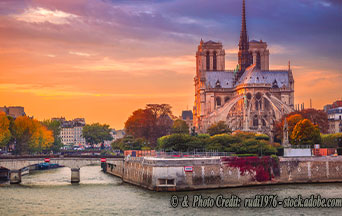
Photo Credit: © rudi1976 – stock.adobe.com
Footnotes
- Pauline Jaricot (1799-1862) founded the Pontifical Society for the Propagation of the Faith. She was beatified on May 22, 2022. Her biography, Pennies for Pauline: The Story of Marie Pauline Garicot, Foundress of the Society for the Propagation of the Faith by Mary Fabian Windeatt was published in 1952. TAN republished it in 1993 under the title, Pauline Jaricot: Foundress of the Living Rosary and the Society for the Propagation of the Faith.
- Joseph Fouché (1759-1820) was Napoleon’s Minister of Police from 1799-1804.
- Antione Lestra, Histoire Secrète de la Congrégation de Lyon, Collection Itineraires; Paris: Nouvelles Editions Latines, 1967.
- Benoît Coste (1781-1845) was a founder of another organization, “The Congregation of the Gentlemen of Leon,” which worked closely with the sodality. According to one source, this organization continued until the late twentieth century.
- Antoine Lestra (1884-1963) was a French monarchist lawyer, journalist and writer. He was a close friend of the princes Sixtus and Xaview of Bourbon-Parma, the brothers of the last Habsburg Empress of Austria-Hungary, Zita.