
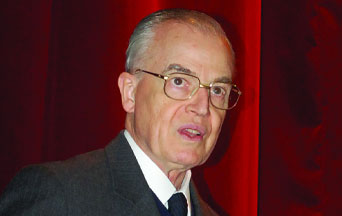
The head of the Imperial House of Brazil, Dom Bertrand, explains his views on government and faith, arguing that ‘if God is removed from the picture, the state becomes God.’
Many would raise an eyebrow if you claimed that Brazil was once the actual seat of a European monarchy and that Rio de Janeiro served as the capital of the realm. Even more striking is the fact that the Brazilian royal family still exists (more precisely, the imperial family), even though it has no public duties or roles, and that the current head of the Imperial House of Brazil, Prince Bertrand of Orleans-Braganza, is a devout Catholic who receives Communion daily. “I have received Holy Communion every day of my life since I was 17 (he is 84 now). I remember missing Communion only twice: once in Bolivia because of a curfew, and once in Washington, D.C., due to a snowstorm.”
The prince, formally addressed in Portuguese as Dom Bertrand set aside a few minutes to speak about his views on the relationship between politics and the Catholic faith.
A Brief History
Dom Bertrand’s lineage reads like a panorama of some of Europe’s most prominent monarchs. Besides all the Portuguese royals, his family tree includes Emperor Maximilian I of Austria, Charlemagne and Charles V of Spain. He is especially proud to descend from canonized saints, including Saint Elizabeth, Queen of Portugal, Saint Nuno of Saint Mary, Saint Vladimir the Great and Saint Louis IX of France.
In 1807, as Napoleon conquered vast portions of Europe, Portugal found itself under imminent threat. To outmaneuver the French, the Prince Regent of Portugal, Dom João VI—also a direct ancestor of Dom Bertrand—transferred the capital of the sprawling, four-continent Portuguese Empire to Brazil in 1808. The move ensured the monarchy’s survival and ushered in a new era in the Americas.
From that moment on, Brazil became the seat of the Portuguese Empire, with the city of Rio de Janeiro as its capital. The arrival of the Portuguese court transformed Brazil, which, until then, had been a colony with no national unity beyond its geography and was composed of nearly autonomous provinces. The country’s cohesion as a nation grew stronger, leading to a notable period of progress in which libraries, schools, industries and urban development initiatives, among other advancements, flourished.
In 1822, Dom João VI’s son, Dom Pedro I, proclaimed Brazil’s independence, turning it into a new and thriving empire itself with one of the world’s most powerful navies, the first long-distance submarine telegraph cable connecting South America to Europe, the world’s first modern postal systems, one of the highest literacy growth rates in the Western Hemisphere, and the biggest industrial park in Latin America.
In 1889, however, a military coup d’état—carried out without any popular involvement—transformed the country from a monarchy into a republic, forcing the royal family into exile. Dom Bertrand, who was born in France during the exile, maintains that the Brazilian Republic has been a failure and that if Brazil had maintained its monarchy, it would be a far more developed country.
The Benefits of the Monarchy
Some regard monarchy as an outdated and ornamental institution wherever it exists. Dom Bertrand disagrees. He argues that Brazil’s remarkable development during its brief monarchical period is exemplary, as is the success of modern constitutional monarchies, such as Japan.
He credits Dom João VI’s relocation to Brazil with ensuring the survival of the lusophone world. “Even today, compare former Portuguese colonies with the regions around them,” he says. “Goa in India, Macau in China—they have a different culture and stability. They still miss the Portuguese. When Portugal underwent the ‘Carnation Revolution’ in 1974, colonies such as Mozambique and East Timor were handed over to socialists, against their will. Take East Timor, for example: it was invaded by Indonesia, its recovery was led by Timorese Catholics with Australia’s help. East Timor refused to adopt English as an official language, saying they preferred to remain poor speaking Portuguese rather than adopt English.”
Questioned about some nations, such as the United States, that never had monarchies and still prospered, Dom Bertrand said: “Americans, deep down, would love to have a king. Just look at the success of British royals when they visit. I go there often and am warmly received. Why? Because I am a Catholic prince.”
To him, monarchy is the most natural form of government. “Monarchy is based on a divine institution: the family. What is a family if not a small monarchy? The father is the king, the mother the queen, and the children are the faithful subjects. This structure provides stability. A king is not a tyrant but a guide who encourages the qualities of the people, restrains their faults, and leads them toward a common goal—just as a good father nurtures his children.”
The Stability of the Monarchy
The stability provided by the monarchy is one reason Brazil is such an important country today. “Unlike our Spanish-American neighbors, Brazil’s independence was peaceful, ensuring national unity and territorial integrity. This is why we remain the world’s fifth-largest country and the second-largest agricultural producer, right after the United States,” he notes.
Beyond material progress and peace, the monarchy granted stability to Brazil. The prince notes that “In a republic, every four years there is a violent struggle for power.”
Brazil’s first constitution in 1824 declared Catholicism the official religion of the Empire. “There was harmony between the temporal and the spiritual spheres, between Church and State, which provided extraordinary stability,” stated Dom Bertrand.
Portugal (including its monarchs) has historically been one of Europe’s most Catholic nations. Its national story begins with Dom Afonso Henriques in the twelfth century—also Dom Bertrand’s direct ancestor. According to tradition, he saw a vision of Christ during the Battle of Ourique against the Moors. Our Lord secured his victory, which led him to become Portugal’s first king.
Portugal’s Great Worldwide Influence
Some scholars, however, argue that the transfer of the seat of government from Lisbon to Rio de Janeiro in 1808 exposed Portugal’s weakness and its subsequent inability to resist the Napoleonic offensive. This weakness, they say, was a symptom of internal backwardness brought about, among other factors, by its Catholic faith and the resulting obsolescence in its customs.
Dom Bertrand rejects this idea: “Portugal—and later Brazil—had stability precisely because it was a Catholic civilization, interrupted only briefly by the Marquis of Pombal.” Indeed, at the beginning of the nineteenth century, Portugal itself was a nation whose means of action were far inferior to the size of its Empire. On the one hand, this situation could suggest a certain inertia regarding internal development (why did such a rich country not evolve more?); on the other hand, it highlights the greatness of Portuguese achievements, even with limited means at their disposal.
Dom Bertrand continues: “Portugal, like the rest of the world, was a victim of the decline of Christendom initiated in the Renaissance, when societies shifted from a theocentric to humanist perspective.”
Christendom
For Dom Bertrand, the Renaissance marked the beginning of the end of Christendom, ushering in a growing tendency to divinize man. The Protestant Reformation amplified this shift, although Portugal was less affected due to its strong Catholic roots. Then came the Enlightenment, communism, and today’s cultural revolution, “which is destroying what remains of Christendom—with abortion, divorce, and all these crimes against God’s Law,” he asserted.
King John of England is associated with the first significant constitutional document of the modern Western tradition. However, Dom Bertrand points out that Saint Stephen of Hungary preceded him, making the Ten Commandments the basis of his country’s constitution. He says:
“This is what Saint Augustine points to in The City of God: a city, nation, or region in which everyone respects the will of God. It is what we pray for every day in the Our Father when we say, ‘Thy kingdom come, Thy will be done, on earth as it is in heaven.’ Our mission is to make this world a reflection of heaven and to sanctify society. As a nation becomes virtuous, it progresses. When it abandons the law of God, what we see today happens. The only solution to current problems is the restoration of Christendom.”
The Secular and Liberal State
The head of the Imperial House of Brazil makes it clear that he is against the secular state. “If God is removed from the picture, the state becomes god and considers itself entitled to override natural law and decide on the family, abortion, divorce, euthanasia…. According to Catholic doctrine, in temporal matters the state has the final word, but in religious matters, and in matters involving both spheres, the Church has the final word because it is the Church that must safeguard natural law (the family structure, the education of children, property, legitimate defense, etc.), which comes not from a law but from creation.”
To those who raise the issue of freedom of worship in a Christian state, Dom Bertrand responds: “I am Catholic, and the only Church with full rights is the Catholic Church. Non-Catholic churches are tolerated. That is how it always was in Christendom, and that is how it was in the Brazilian Empire. I cannot hold a gun to someone’s chest and say, ‘Either you convert or you die,’ because that is contrary to natural law, but I must do everything possible to convert that person and ensure that society respects the law of God.”
The Divine Commission
Asked about Cardinal Matteo Zuppi’s recent statement that “the end of Christendom is not a defeat, but a kairòs: the chance to return to what is essential, to the freedom of the beginnings,” Dom Bertrand disagreed, saying, “I consider this statement, with all due respect, contrary to what we pray for in the Our Father. The commission that Our Lord Jesus Christ gave to the apostles was: ‘Go and evangelize all peoples.’ This applies to the apostles, to me, and to everyone. It is in God’s plan that all peoples respect the law of God. I cannot be satisfied knowing that some peoples respect the laws of God and others do not. We must desire the restoration of Christendom throughout the entire world. If I desire the good of my neighbor, what is the greatest good I can desire for him? That he be Catholic, that he respect the law of God, that he sanctify himself, and prepare for eternal life…”
There is an excellent example in this matter: the Parliament of Monaco approved abortion, but the prince did not promulgate the abortion legislation. A head of state who approves abortion is responsible for all the children who will be killed. Certain crimes cry out to heaven for vengeance.
The Restoration of Christendom
Given Dom Bertrand’s defense of the restoration of Christendom, the question arises as to which historical period should serve as a positive example for today: “The height of Christendom was the Middle Ages. About that period, Pope Leo XIII affirmed in the encyclical Immortale Dei: ‘There was a time when the philosophy of the Gospel governed the states.’” He continues: “Just as I cannot be indifferent to the law of God, society cannot be either. Society has the obligation to render worship to God, just like any individual; it cannot be neutral toward God.”
Ukraine, the United States, and the Hope for the Future.
Dom Bertrand cites several of his own ancestors as models of good governance. He includes explicitly Saint Louis IX of France—“still considered France’s greatest monarch”; King Ferdinand of Castile—“who devoted his reign to fighting the Muslims persecuting the Catholic faith”; and Saint Vladimir the Great—“who converted himself and his entire nation.”
Speaking of Saint Vladimir led him to address the current war in Ukraine: “I am outraged by efforts to hand Ukraine back to Russia. Russia is ruled by communist lackeys. In this war, Ukraine is like a small David striking a massive Goliath. Recently in Ukraine, the Catholic population has grown from 8% to 12%, and entire dioceses of the heretic Orthodox Church have entered the Catholic Church. They see who the true patriots are: the Catholics. In the extraordinary Maidan protests, there were Masses and processions to Our Lady of Fatima.”
He also commented on the United States, whose future he views with optimism thanks to a surge in conversions. “An American bishop recently told me that, despite Catholics not being the majority of the population, Catholicism is the largest religion. Many Protestants are converting. There are more than a thousand churches with perpetual Eucharistic adoration. This attracts God’s blessings. The solution for the U.S., as for Brazil, is the conversion of the nation to Catholicism.” He adds: “Look at Mother Angelica’s success in the U.S., for example—truly extraordinary.”
Our guest interviewee concluded by returning to the divine mandate: “We are obliged to evangelize all peoples. If I can bring someone to the Catholic faith, I must. I will be judged by the effort I made—or failed to make—to convert that person.” Despite what he calls a crisis of faith, he places hope in the younger clergy: “There is a movement among younger priests to return to tradition, to the cassock, to Latin, to the sacraments, to the splendor of the liturgy. Hope relies on young people.”
This article originally appeared in LifeSiteNews at this link. Minor edits for clarity have been made here.