
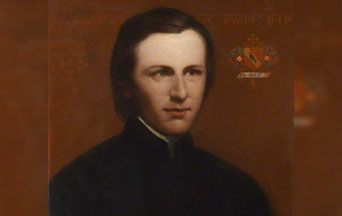
The following article is one of a four-part series that features the life of Augustus Pugin, the renowned English Catholic architect of the nineteenth century.
When examining the great Catholic figures, architects seldom rank among them. Augustus Welby Northmore Pugin is a name known to relatively few, but his influence is all around us. He was not a great saint, warrior, martyr or theologian. History remembers him as an influential architect.
However, he accurately saw himself and the movement he headed as far more. He saw the late medieval period as the epitome of European Christian Culture and set himself to the monumental task of reviving and extending it in the nineteenth century.
Absorbed into the Church
This short series of articles will explore Augustus Pugin’s life and the task he adopted.
Augustus Pugin was one of those rare individuals who applied a single set of well-thought-out principles to all aspects of his life. In 1834, the twenty-two-year-old Augustus Pugin converted to Catholicism, and his allegiance to Holy Mother Church dominated everything else.
Modern life teaches the opposite lesson, counselling that one path to success is “compartmentalizing.” Following that pattern, many people exercise one set of principles in their family life, another among their friends and a third set in their career. Medieval man led a more unified life, and all of his relationships were dominated by his level of commitment to the Church.
One might say that Pugin was absorbed into the Church. His entire life led him in that direction. Such absorption, however, is not immediate. It requires time and grace for a boy to become the leader whose life continues to exert as significant an influence as that which Pugin continues to exercise.
A Child of Very Different Parents
Ten years before Pugin’s birth, the poet William Wordsworth famously quipped that “the child is father of the man.” That is undoubtedly true in Pugin’s case.
Augustus Pugin was born on March 1, 1812, in the waning days of Georgian England. His parents were a singular couple, and both—albeit in different ways—would have been surprised by the son they raised.
Mr. Pugin inherited his artistic temperament from his father, Auguste Charles Pugin, a Frenchman who migrated to England due to the French Revolution. The elder Pugin was a draftsman of rare ability who worked with some of the leading architects of his day. He also maintained a drawing school out of the family home in the Bloomsbury district of London. A thoroughly secular character, he was much more at home with the spirit of the so-called Enlightenment than his son would ever be.
Auguste’s artistic temperament attracted the notice of a very different character, Catherine Welby, whom he married on February 2, 1802. Theirs was an unlikely union. He was a Frenchman on the fringes of the artistic world. She was a thoroughly English, plain-spoken, Protestant middle-class girl of Calvinist leanings. Hers was a long-standing merchant family, reasonably wealthy but otherwise unremarkable.
However unlikely their marriage may have been, it does appear, from what little we know, to have been successful. Both parents doted on their only child to reach adulthood, and young Augustus can be said to have combined his father’s artistic temperament with his mother’s earnestness. This potent combination led to an almost obsessive productivity.
His Mother’s Calvinism
Unfortunately, besides many drawings and other bits of physical evidence, we know little about Pugin’s early years. Pugin wrote clearly and forcefully about his opinions. However, he wrote little about himself. By nature, he was neither introspective nor self-promoting.
One of the few elements of his childhood he recorded was his mother’s attempt to raise him according to her family’s Calvinist leanings. At her instruction, he spent many hours in the Protestant chapels, sometimes pejoratively referred to as “Preaching Boxes.” These rooms possessed some sense of dignity, but they are—to put it nicely—sparse. Their centerpiece is the pulpit. A plain communion table is at the foot of the pulpit, but it reflects the diminished status of what Protestants called “The Lord’s Supper.” The sole focus was the spoken word, most often in the form of sermons that could be two hours long.
Such settings mesh with cerebral and emotionless Calvinism. In them, a single verse might be analyzed and re-analyzed to draw out what the Calvinists saw as its correct interpretation. For Pugin as a boy, this was a kind of torture.
A Developing Aesthetic Sense
Pugin’s intellectual and aesthetic senses were considerably more stimulated by his father’s work. Auguste Pugin enjoyed taking his students on drawing tours, where they would visit a site—usually a medieval cathedral – and sketch its many details. The students might spend hours trying to capture the essence of a single bit of ornament. Unlike the hours spent in his mother’s Protestant chapel, these sessions brought the young Augustus a most sublime pleasure and were a kind of architectural apprenticeship.
Pugin’s tendency to overwork and eager mind emerged in his late teens. Probably due to his father’s contacts with England’s most famous architects, he got a contract to design furniture for Windsor Castle. He also set up an unsuccessful company to provide wood and stone carvings to other architects.
At about the same time, he also drifted into the London theater scene, designing scenery for stage productions. In that milieu, he observed and learned how light and color could excite others’ emotions. These lessons would suit him well in his chosen profession. Even today, many scholars refer to his architecture as “dramatic.”
A Brutal Coming of Age
At nineteen, he married Anne Garnet, about whom we know little other than that they met through his theatrical work. Less than a year after their marriage, she died in childbirth, although the child—a daughter—survived. The following December 19, his father died. About four months after his father’s death, on April 28, 1833, his mother died as well.
It is not hard to imagine the wrenching effect of these three losses on a young man.
Pugin’s biographer, Rosemary Hill, sums up the effect.
“For Pugin, it was a brutal coming of age. The household that had been his only home, his school, the place where he had met his first friends, lived with his wife and where his daughter had been born, was now entirely broken up. The long life encompassed in his first twenty-one years was over. He was left, with [his daughter] Anne, to begin the world again.”
After his wife’s and parents’ deaths, his frenetic activities continued and included a serious inquiry into religious matters. Pugin proceeded into the world wherein he was most comfortable: the medieval cathedral. Where he had once studied its architectural details, he now studied the purposes that inspired those details. He underwent a metamorphosis as he studied the buildings and the liturgies that had taken place in them. Starting as a lapsed Calvinist, he gravitated toward the increasingly popular “high church” Anglicanism but didn’t stay there long.
In 1834, he converted to Catholicism and was officially received into the Church the following year. From that stem, an amazing career would grow.