
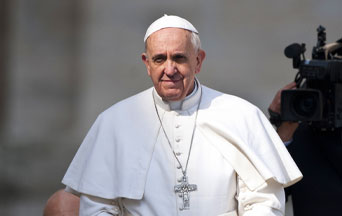
Photo: © Mazur/catholicnews.org.uk, CC BY-NC-ND 2.0
At a time when the sexual revolution is at its height, and when fashions, laws, and customs favor the sin against chastity, we have a pope who is not showing indignation against those closely or remotely responsible for this situation but rather complains about those upholding Church doctrine and carefully defending the virtue.
For the first time in history, a pope shows contempt for those who uphold the virtue of chastity!
That happened on August 5th during his trip to Portugal for the World Youth Day in Lisbon.
“What I don’t like at all…”
The Church has always taken great care to defend the angelic virtue. Yet in a conversation with Jesuits in Portugal, Pope Francis referred to this care in a contemptuous tone, saying: “But what I don’t like at all, in general, is that we look at the so-called ‘sin of the flesh’ with a magnifying glass, just as we have done for so long for the sixth commandment.”
While the Church has always recommended prudence and vigilance in such delicate matters, Pope Francis considers this practice as “looking at the so-called ‘sin of the flesh’ with a magnifying glass.” In other words, such concern is an unbalanced exaggeration, even when it extend to the homosexual sin as we will later see.
Eternal and Natural Law: The Foundation of Morals and Law
Forgetting Saint Paul’s warning to the Ephesians (5:3-4),1 he refers to sins against the angelic virtue with such a vulgar expression we would not quote except for the need to show the depths of the abyss to which the present pontificate has descended. He says we are not concerned with other sins while “[i]nstead, sins below the waist were relevant.”2
The context of this statement can be understood as saying that sins against chastity and more particularly the most aberrant—sins against nature—are irrelevant.
“Really Good” and “Virtuous” Homosexuals, “Very Committed to the Church”
Pope Francis was responding to the Jesuit João, who said: “I do pastoral work every day with young university students, and among them there are many really good ones, very committed to the Church, to the center, very friendly with the Jesuits, and who identify as homosexuals.”3
Note that these are practicing homosexuals, as Jesuit João says: “[T]hey do not see the call to chastity as a personal call to celibacy, but rather as an imposition…[T]hey do not feel, in conscience, that their relationships are sinful.”4
He also states: “[T]hey are virtuous in other areas.”5
The claim that practicing homosexuals can be “virtuous in other areas” cannot go unremarked.
 Learn All About the Prophecies of Our Lady of Good Success About Our Times
According to Saint Thomas, mortal sin “turns man away from God, so as to destroy charity.”6 Now, charity “is the root of all the infused virtues, as virtues.” Therefore, by destroying charity, mortal sin destroys the supernatural virtues at their root.7
Thus, while capable of natural virtue, people who remain in a state of grave sin against chastity, mainly against nature, become incapable of practicing the supernatural virtues needed to live the Christian life of grace. To claim that these people are “virtuous in other areas” despite remaining in this sin, is tantamount to denying that homosexual practice is a mortal sin.
Likewise, it is a very serious error to admit that practicing homosexuals can be “very committed to the Church.”
Can those not “committed” to the practice of the Commandments the Church upholds be really and sincerely “committed to the Church?”
Although those in the state of sin can remain in her bosom, they “are the dead or paralyzed members of the Church, in whom the vital sap no longer flows, as in dead branches.”8
As Our Lord said, “If a man does not abide in me, he is cast forth as a branch and withers; and the branches are gathered, thrown into the fire and burned” (John 15:6).
“‘Righteous and Sinners,’ Everyone, Everyone, Everyone”
Continuing, Jesuit João then asks: “And how can we act pastorally so that these people feel, in their way of life, called by God to a healthy affective life that produces fruit? Should we recognize that their [homosexuals’] relationships can open up and give seeds of true Christian love, such as the good they can accomplish, the response they can give to the Lord?”
A “healthy affective life” in a relationship against nature? Can such a relationship produce seeds of “true Christian love”? Pope Francis seems to accept that it can because, in his reply, he doesn’t make the slightest reservation or restriction to what was said.
10 Razones Por las Cuales el “Matrimonio” Homosexual es Dañino y tiene que Ser Desaprobado
On the contrary, the Pope comments on the parable of the wedding feast of the king’s son (Matt. 22:1-14), in which the guests didn’t come and the King sent his servants along the roads, forcing everyone to enter the banquet hall. He uses this parable to prove that in the Church there is room for everyone, no matter their moral situation: “‘righteous and sinners, everyone, everyone, everyone. In other words, the door is open to everyone, everyone has their own space in the Church…”
Undoubtedly, everyone is called to belong to the Church of God, but only those faithful to its laws and doctrines share in the wealth of divine graces. Even those in mortal sin remain in the Church through baptism and faith. However, it is as if they weren’t because, as we said, they are dead to the life of grace. They are dead members of the Church until reconciled by the sacrament of penance.
This conclusion comes across very clearly in the same parable, a few chapters below the passage Pope Francis mentions. There, we read that the King (Our Lord) examined the guests and found one without the wedding garment, which, according to interpreters, means lacking sanctifying grace.9 Then he said to his servants, “Bind him hand and foot and throw him into the darkness outside, where there will be weeping and grinding of teeth” (Matt. 22:13).
How Do We Build an Organic Society?
Anyone in the Church (the banquet) who does not live according to her moral precepts and doctrine, and thus not in the state of grace (lacking the wedding garment), is not on the road to salvation but on the road to Hell.
Pope Francis agrees with Cardinal Jean-Claude Hollerich
Regarding practicing homosexuals whom Jesuit João called “really good” and “virtuous,” Pope Francis comments: “We must not be superficial and naive, forcing people into things and behaviors for which they are not yet mature, or are not capable.”
Does he mean the Church cannot demand chastity from its members, especially “very committed” ones?
Furthermore, he surprisingly denies that people are incapable of abandoning grave sin with the help of grace and that one needs to “accompany” them in this state until they are “mature” enough to abandon it.
He seems to agree with Cardinal Jean-Claude Hollerich, whom he appointed as relator general of the Synod. In a recent interview with KNA, the German Catholic news agency, he stated that the Church needs to change its doctrine on homosexual relationships: “I believe that the sociological-scientific foundation of this teaching is no longer correct.”10
Changing Moral Doctrine to Accept Homosexuals, “Transgenders,” etc.
Continuing his conversation with his Jesuit confreres, Pope Francis affirms (in his own sinuous way) that the Church’s doctrine and morals “evolve,” change, and that “[t]he view of Church doctrine as monolithic is erroneous.”11
Faith Brings Harmony to Family, Society and State
Concerning moral doctrine, he states: “The problems that moralists have to examine today are very serious, and to deal with them they have to take the risk of making changes, but in the direction I was saying.” Although he implies that doctrinal changes should happen along a line of continuity, the examples he gives run in the opposite direction.
Today, he says, “the death penalty is a sin. You cannot employ it, but it was not so before. … So you change, you change, but with the criteria just mentioned.”
Claiming that what the Magisterium said was licit is now sinful is not continuity but a break with that Magisterium. The lawfulness of the death penalty is established in Scripture, Tradition, and Church practice.12
If one can or should change Church moral doctrine on some points because that doctrine is not monolithic, then one can do the same with homosexual practice or other sins against chastity.
And this could well happen since Pope Francis’s sympathy for homosexuals and “transgenders” is notorious.
During his conversation with the Jesuits of the Portuguese province, he told of a nun who deals with “transgenders”: “One day she said, ‘Can I bring them to the audience?’ ‘Sure!’ I answered her, ‘why not?’ And groups of trans come all the time.”
The Seriousness of the Sin Against Chastity
In the conversation’s context, Pope Francis expressed contempt for those who uphold the virtue of chastity and implied that homosexual practice is considered a sin because of an unhealthy exaggeration.
Devotion to the Heart of Mary Will Save the World
However, this is not what Catholic doctrine states in conformity with the Scriptures, Tradition, and the Church’s constant Magisterium. Let’s look at a few texts.
Saint Paul: Sins of the Flesh Close the Door to the Kingdom of God
Especially in his Epistles to the Corinthians, the Apostle Saint Paul makes Catholic doctrine in this matter very clear:
“You know perfectly well that people who do wrong will not inherit the kingdom of God: people of immoral lives, idolaters, adulterers, catamites, sodomites, thieves, usurers, drunkards, slanderers and swindlers will never inherit the kingdom of God.” (1 Corinthians, 6:9-10)
Of themselves, mortal sins, including those against chastity, lead to Hell.
Our Body Is a Temple of the Holy Spirit
The Apostle shows that we should practice chastity because our bodies are temples of the Holy Spirit and should be honored as such:
“Keep away from fornication. All the other sins are committed outside the body; but to fornicate is to sin against your own body. Your body, you know, is the temple of the Holy Spirit, who is in you since you received him from God. You are not your own property; you have been bought and paid for [by Jesus Christ]. That is why you should use your body for the glory of God.” (I Corinthians, 6:18-20)
Consequences of the Vice of Impurity
As Original Sin caused our tendencies to become disordered, and the urge to procreate is one of man’s most powerful instincts, the Church always understood one’s need to be as vigilant as possible against the temptations of the flesh to preserve chastity for the love of God.
Saint Alphonsus de Liguori, the Prince of Catholic Moralists, dealing with the sin of impurity, says that “most souls fall into hell” because of this sin.13
Science Confirms: Angels Took the House of Our Lady of Nazareth to Loreto
Saint Gregory the Great shows the harmful consequences of the vice of impurity:
“From lust are generated blindness of mind, inconsiderateness, inconstancy, precipitation, self-love, hatred of God, affection for this present world, but dread or despair of that which is to come.”14
Therefore, like every mortal sin, the vice of impurity entails hatred of God whose law the sinner willfully disobeys. With that, he loses his lucidity, his desire for Heaven, and becomes attached to this world.
As Saint Thomas says, impurity is one of the capital sins which cause other sins.15 The Prophet David is an example of how impurity leads to other sins. He allowed himself to be carried away by an adulterous passion for Bathsheba, and he ended up causing the death of Uriah, her husband (2 Samuel 11-12).
Chastity is necessary not only for individuals to lead virtuous lives but also for social life. Without it, fidelity in marriage becomes impossible and destroys the family, the basis of society. It also causes feuds, enmities, etc.
The Synod on Synodality
Inevitably, in this torrential conversation with his Portuguese confreres, Pope Francis refers to the Synod on Synodality: “It was Paul VI at the end of the Council who realized that the Catholic Church had lost the sense of synodality. The Eastern part of the Church maintains it.”
An excellent book on this subject has just come out: The Synodal Process Is a Pandora’s Box: 100 Questions & Answers, by José Antonio Ureta and Julio Loredo de Izcue. This well-documented book shows all the errors in the Synod initiative, so we recommend it to our readers.16
Taking a Principled not a Personal Stand on Homosexuality, Homosexual “Marriage” and Transgenderism
As practicing Catholics, we are filled with compassion and pray for those who struggle against violent temptation to sin, be it toward homosexual sin, gender dysphoria or otherwise.
We are conscious of the enormous difference between these individuals who struggle with their weaknesses and strive to overcome them and others who transform their sin into a reason for pride, and try to impose their lifestyle on society as a whole, in flagrant opposition to traditional Christian morality and natural law. However, we pray for them too.
According to the expression attributed to Saint Augustine, we “hate the sin but love the sinner.” And to love the sinner, as the same Doctor of the Church explains, is to wish for him the best we can possibly desire for ourselves, namely, “that he may love God with a perfect affection.” (St. Augustine, Of the Morals of the Catholic Church, No. 49, www.newadvent.org/fathers/1401.htm)
Footnotes
- “Immorality or any impurity or greed must not even be mentioned among you, as is fitting among holy ones; no obscenity or silly or suggestive talk, which is out of place, but instead, thanksgiving” (Eph. 5:3-4).
- Antonio Spadaro, S.J., “‘The Water Has Been Agitated’: Francis in conversation with Jesuits in Portugal,” La Civiltà Cattolica, August 28, 2023, https://www.laciviltacattolica.com/the-water-has-been-agitated/, retrieved Aug. 29, 2023.
- Idem.
- Idem.
- Idem.
- Saint Thomas Aquinas, Summa Theologica, I-II q. 87, a.3.
- Id. I-II, q. 71, a. 3.
- Pietro Parente, Antonio Piolanti, Salvatore Garofalo, Dictionary of Dogmatic Theology, (Milwaukee: The Bruce Publishing Company, 1951), “Members of the Church,” p. 183.
- Cornelius a Lapide, The Holy Gospel According to Saint Matthew, Vol. II in The Great Commentary of Cornelius A Lapide, p. 357.
- Katholische Nachrichten Agentur, “Top EU Cardinal Calls for Change in Church Teaching on Gay Relationships,” National Catholic Reporter, Feb. 2, 2022, https://www.ncronline.org/news/quick-reads/top-eu-cardinal-calls-change-church-teaching-gay-relationships.
- Spadaro, ‘The Water Has Been Agitated.’
- See Avery Cardinal Dulles, “Catholicism & Capital Punishment,” First Things, 112, April, 2001, 30-35, https://www.firstthings.com/article/2001/04/catholicism-capital-punishment.
- Saint Alphonsus Liguori, Theologia Moralis – Moral Theology, Translated by Ryan Grant (Post Falls, ID: Mediatrix Press, 2017), Vol. I, Book III, No. 413, p. 465.
- The Books of the Morals of St. Gregory the Pope, Vol. III—The Sixth Part, Book XXXI, 45, No. 88, http://www.lectionarycentral.com/gregorymoralia/book31.html; Summa Theologica, II-II, q. 153, a. 4.
- Summa Theologica, I-II, q. 3; Id. II-II, q. q. 153, a. 4.
- José Antonio Ureta and Julio Loredo de Izcue, The Synodal Process Is a Pandora’s Box: 100 Questions & Answers, TFP.org, August 22, 2023, https://www.tfp.org/the-synodal-process-is-a-pandoras-box/.