
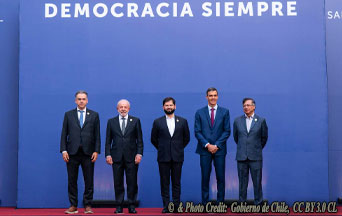
On July 21, Chilean President Gabriel Boric welcomed his counterparts from Spain, Brazil, Colombia, and Uruguay to Santiago for a meeting of Latin leaders from the continent and Spain.
The meeting’s theme was “Always Democracy,” alluding to the need to strengthen democracy in the face of growing right-wing movements worldwide.
Now that the summit is over, a serious question needs to be answered: Was the event really a democratic summit, or did its theme only serve to hide a contrary agenda?
Let’s look at the facts.
1. Lack of Representation and Ideological Diversity
The meeting was limited to representatives of the left. The hallmark of any meeting that calls itself “democratic” is that it represents a wide range of ideas.
Eternal and Natural Law: The Foundation of Morals and Law
A democracy that brings together only members of a single party or ideology is not, strictly speaking, “democratic.” It would be a typical manifestation of a one-party regime, opposed to the commonly accepted meaning of the concept of democracy.
2. The Left’s Self-referential Discourse
The summit did not focus on issues like security and violence, which seriously afflict societies throughout Latin American countries. Instead, the speeches of those present concentrated on attacking “right-wing extremism.”
Spain’s Pedro Sánchez spoke of a “Hate International,” Brazil’s Luiz Inácio “Lula” da Silva compared the far right to Nazism, and Colombia’s Gustavo Francisco Petro attacked neo-liberalism and capital.
The summit fueled the polarization it claimed to combat, aggravated the breakdown of diplomatic bridges, solidified the image of an ideologized left and ignored the real security priorities of the populations it represents.
The summit’s left-wing ideological tone caused many people to pay little attention to the meeting or its conclusions. The leftist ideas were far removed from the purpose that brought them together.
3. Selective Hypocrisy about Democracy
What made matters worse was the summit’s selective hypocrisy when dealing with democracy. While denouncing the right’s “authoritarianism,” the signatories of the summit’s final document avoided condemning regimes such as those in Cuba, Venezuela and Nicaragua. During the very days of the summit, these regimes were systematically violating human rights and restricting democratic freedoms.
What the Popes Have to Say About Socialism
Thus, Venezuelan dictator Nicolas Maduro sensed no opposition or sanctions from the summit. A few days after the event, he celebrated the first anniversary of his latest electoral fraud. He further mocked the unfortunate Venezuelan people by decreeing ten days of musical celebrations throughout his nation’s impoverished territory to commemorate the pseudo-victory.

Download Ebook or
Order PRINT Copy
4. President Boric Celebrates the Communist Party Candidate
The summit gave implicit support for the errors of Communism. Weeks before this international summit, Jeannette Jara, a member of the Chilean Communist Party, was elected as the presidential candidate of the coalition of parties supporting President Boric. Among many other anti-democratic opinions, she stated that Cuba had a “special” form of democracy. Such statements did not elicit any negative reaction from this meeting’s host. On the contrary, he fully supported her bid to become president.
Anyone who promotes a communist candidate who makes no secret of her sympathies for Cuba’s oppressive regime is, ipso facto, disqualified from being considered a “democrat,” let alone from organizing an event of this nature.
5. An Inopportune Call
Both the call for the meeting and its statements represented challenges to the U.S. president’s administration at a time when all the countries on the continent are trying to manage their relations with the U.S. carefully.
The meeting’s participants preferred to flaunt their leftist ideology, risking new tariff sanctions that could further worsen the fragile economic situation on the continent. This attitude will have obvious consequences for the lives of all its inhabitants.
 Read About the Prophecies of Our Lady of Good Success About Our Times
Prioritizing leftist ideological preferences over their nations’ well-being shows contempt for the populations they govern and is the opposite of what one should consider when discussing “always democracy.”
Consequently, the summit fueled the polarization it claimed to combat, aggravated the breakdown of diplomatic bridges, solidified the image of an ideologized left and ignored the real security priorities of the populations it represents.
6. Doubling Down on Their Mistake
Despite the summit’s empty and vague proposals, these conclusions will be presented at a new meeting next September during the 80th session of the United Nations General Assembly in New York.
Far from “always democracy,” this attitude of the participating heads of state recalls the phrase of Nazi propaganda chief Joseph Goebbels, who argued that “a lie repeated a thousand times becomes the truth.”
Photo Credit: © Gobierno de Chile, CC BY 3.0 CL