
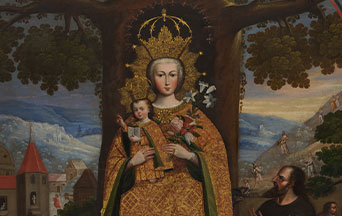
To the progressive mind, a religious vocation is almost a sociological event in which a person agrees to serve “the people of God” and seek social justice. To the more traditional Catholic, a religious vocation is a Marian response to God’s personal calling to follow Him.
These clashing conceptions yield vastly different results. Vocations in progressive dioceses or religious orders often struggle to find candidates. Some, for example, have years where they receive no candidates. On the other hand, religious institutions that confide in Our Lady are often youthful and flourishing.
Why America Must Reject Isolationism and Its Dangers
A recent study explains the connection between devotion to Our Lady and the discerning and sustaining of priestly and religious vocations. It provides impressive proof that this traditional devotion is fruitful.
A Survey on Mary
On July 16, the Center for Applied Research in the Apostolate (CARA) at Georgetown University released a report titled “Impact of Mary, Mother of the Church, on Ecclesial Vocations.” Sister Thu T. Do and researcher Jonathon L. Wiggins prepared the study at the request of the Diocese of Saginaw, Michigan.
The study consisted of a 2025 spring survey of 1,091 American respondents of six groups, which included bishops, diocesan priests, permanent deacons, deacon directors, and superiors of men and women religious.
The questions focused on how devotion to Our Lady influenced their call to the priesthood or religious life. For the vast majority, Mary crossed their paths at some point in their lives and continues to do so now.
The Impact of Marian Devotion
Fifty-nine percent of all respondents reported that Marian devotion had a “meaningful” or “great” impact on discerning a vocation. Religious priests felt the most impact, with 71 percent, while deacon directors felt the least impact, at 49 percent.
After discernment, some 74 percent of respondents claim that devotion to the Blessed Mother either “strengthened” or “very much strengthened” their fidelity to their respective vocations.
In addition, Marian devotion had a “meaningful” or “great” impact upon 80% of respondents’ current Eucharistic piety.
Where It Happened
The overwhelming majority of respondents (92%) reported being exposed to Marian devotion in their childhood. The family was the primary source of exposure for 79 percent, while parishes and Catholic schools each accounted for a 44 percent rating.
Eternal and Natural Law: The Foundation of Morals and Law
In 80 percent of the cases, the home was the primary place for their Marian devotion during discernment, followed closely by the parish with 77 percent.
Other Related Devotions and Practices
Other Marian factors contribute to discerning and sustaining religious vocations.
It is no surprise that the Holy Rosary was the most frequently practiced Marian devotion among respondents during their discernment processes. Seventy-one percent reported praying it privately, while 52 percent said it with others.
The study cites the use of Marian sacramentals. When asked if they “often” or “always” wear the Miraculous Medal, 32 percent said yes. Twenty-nine percent wear the Brown Scapular while 18 percent use another Marian medal.
Some 44% of respondents claim pilgrimages to Marian shrines played a role in discernment. Guadalupe (29%) and Lourdes (28%) were the most popular sites.
The most popular Marian author was Saint Louis-Marie de Montfort, author of True Devotion to Mary and promoter of consecration to the Blessed Virgin as a slave of love. In survey commentaries, some mention being consecrated to Our Lady.
Lessons From the Survey
The survey results provoke many questions about modern recruitment methods based on the social justice model. The abstract and impersonal appeal to class struggle narratives attracts no one. Empty convents, closed seminaries, and abysmally low diocesan ordination rates prove that this approach does not work.
The rule has always been that where devotion to Our Lady is strong, there also are vocations. Candidates sense the personal attraction of the Mother of God, who favors her devotees with special graces.
 Read About the Prophecies of Our Lady of Good Success About Our Times
The tragic question is why this centuries-proven approach is not applied universally. One cannot help but get the impression that this essential devotion was deemed of secondary importance, leaving many respondents to cultivate it on their own. While encouraging, the percentages recorded by the survey should be much greater.
The lesson from the CARA study is obvious. Recourse to the Mother of God must be given the highest priority. With such evidence, the strategies for increasing vocations should be obvious. Vocation directors should look for those with devotion to Our Lady. Seminaries and convents should cultivate devotion to Mary. Catholic families could become seedbeds of vocations when consecrated to her.
Our Lady is the answer to the vocation crisis if only people would adopt her fiat as their supreme model.