

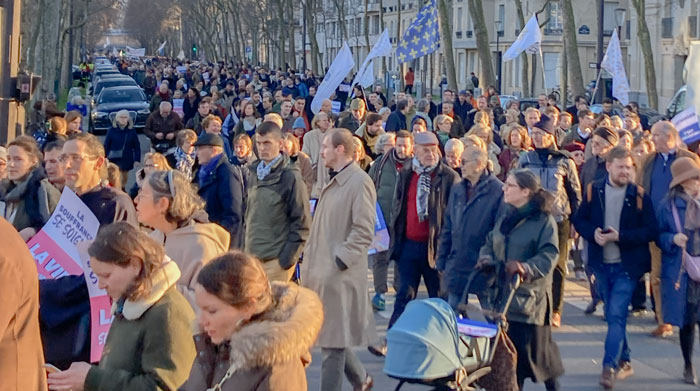
On Sunday, January 18, 2026, an enthusiastic and energized crowd of approximately 10,000 people attended the annual French Marche pour la vie in Paris. The event, held at the Place Vauban directly in front of the Hôtel des Invalides, was a strong signal to France and the world that, in spite of recent defeats, the pro-life movement in first-born daughter of the Church is not only alive but growing.
This year’s march was notable for its large number of young people and very visible Catholic presence. Groups of high school and college students came from across France singing Catholic songs, praying the rosary, and chanting pro-life slogans. The president of the Marche pour la vie, Guilhaume de Theuilloy, reminded participants that “demonstrations are not the only way to fight…Prayer is truly fundamental, as is the vigil for life that takes place the night before [the march] at Saint-Roch Church. The culture of death is an unleashing of the devil’s work, who fights savagely against humanity.” Mgr. Dominique Rey, bishop emeritus of Fréjus-Toulon and the only bishop present, affirmed in his speech, “Respect for life today is a call from Heaven. It is at the heart of the Church’s mission.”

A number of French pro-life organizations took part in the march including Droit de Naître, SOS Tout-Petits, Les Éveilleurs and Renaissance Catholique. Pro-lifers came from other European countries as well as the United States. Both in content and tone, the Marche pour la vie takes much of its inspiration from the annual American March for Life held every January in Washington, D.C. French branches of US pro-life organizations such as 40 Days for Life and Rachel’s Vinyard were present. Like the US march, the French pro-lifers express a militancy and confidence in spite of setbacks and lost battles. In Paris this year, the Marche pour la Vie paid tribute to the American conservative leader Charlie Kirk, a staunch defender of the unborn, who was tragically assassinated on September 10, 2025.
The defense of the unborn, elderly, and terminally ill in France could not be more urgent. When the United States Supreme Court in 2022 overturned the infamous Roe vs. Wade decision – thereby allowing individual states to ban abortion – European progressives were shocked. British Prime Minister Boris Johnson called it “a big step backwards” while French Prime Minister Elisabeth Borne called it “a dark day for women’s rights.” President Emmanuel Macron vowed to make France the first country to enshrine the “guaranteed freedom of access to abortion” in the country’s constitution, and accomplished that on March 4, 2024 with overwhelming majorities in both the French National Assembly and Senate.
The major theme of the march for life this year was the fight against assisted suicide.
Fulfilling one of his campaign promises from 2017, on March 27, 2025 by a vote of 305 to 199 President Emmanuel Macron’s government passed a euthanasia law in the National Assembly. It still is waiting for a vote in the Senate, but if passed the law would be one of the world’s most permissive euthanasia laws putting France in the same category as Belgium and Canada.
Marie-Lys Pellissier, spokeswoman for the Marche pour la vie, told Le Figaro: “We do not want a society that kills, but one that protects and supports the most vulnerable at all stages of their lives, regardless of their level of dependency and the cost of their existence.”
While the theme of assisted suicide is the most politically pressing issue, the fight over abortion is not over. One the one hand, the abortion rate is climbing. In 2023, 243,300 abortions were performed in France, the highest number since 1990 and one of the highest numbers ever recorded. At the same time, the birthrate is plummeting. In 2025, France’s birthrate fell to 1.56 children per woman, the lowest level since the end of World War I. That same year also saw the lowest number of births since 1942, and was the first time since the end of World War II that the number of deaths (651,000) exceeded the number of births (645,000). France’s population of 69.1 million has grown slightly only due to immigration. By 2030, people aged 65 and older will be more numerous than those under 20.
In January 2024, the same year he pushed through the constitutional protection of abortion, President Macron recognized the demographic crisis in France and gave a speech where he called for a “demographic rearmament.” He announced the creation of new government assistance programs to help increase the birthrate. These hypocritical measures will do nothing to stem the tide of the inevitable demographic collapse thanks to 51 years of legal abortion.

European progressives, in fact, are deeply worried that a growing pro-life movement in Europe threatening the future of legal abortion. In 2025, Amnesty International published a study When rights aren’t real for all: the struggle for abortion access in Europe. The report, while optimistic about the future, nevertheless betrays a deep fear that the future of abortion rights is far from certain. The report attacks the existence of “a well-resourced global anti-gender movement” that is forcing progressives to defend “hard-won gains from harmful and retrogressive roll back on existing access to abortion.”
If the progressives who promote the culture of death are worried, it is because they are much weaker than they appear. The abortion and assisted suicide movements depend on the false “consensus” of universal support for their cause. As the American example demonstrates, if even a few Europeans stand up and fight back they can break this consensus and force the culture of death of step back, which is nothing more than a giant with feet of clay.