
This article is part three of a three-part series on Americanist Heresy. It is based on the author’s meeting on February 12, 2025, at the American TFP’s headquarters in Spring Grove, Pennsylvania. Click here to read part one or two.
* * *
The scientific world defines a catalyst as “an agent that provokes or speeds significant change or action.”
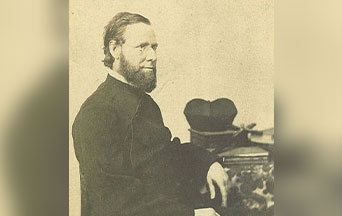
That description fits Father Isaac Hecker. He probably never called himself an Americanist, and he certainly never heard of the heresy bearing that name because it did not flare up until after his death. Nonetheless, it is accurate to call him the catalyst of the Americanist controversy.
Son of the “Enlightenment”
Isaac Hecker (1819-1888) was born into a Protestant family and spent his young adult years as part of Ralph Waldo Emerson and Henry David Thoreau’s so-called Transcendentalist Movement. Bishop John McCloskey of New York received Mr. Hecker into the Church in 1844, and a year later, the young man entered a Redemptorist novitiate in Belgium. He was ordained a priest in 1849 and served as a Redemptorist missionary until 1857.
Why America Must Reject Isolationism and Its Dangers
His relations with his Redemptorist superiors were rocky. He reasoned that the Church needed to adopt missionary tactics suitable to the unique situation in America. Not to do so, he argued, would make the Church’s efforts ineffective, resulting in the loss of souls. In 1857, he went to Rome to defend his view before the Redemptorist Superior General. Appalled at the fact that Father Hecker had gone to Rome without permission, the superior general instead expelled him from the order.
A New Order
Under normal circumstances, that would have been the end of his career. However, three circumstances played out in Father Hecker’s favor. First, he had a reputation for personal piety. Second, he was a spellbinding speaker with a reputation for gaining converts. Last, and perhaps most important, the United States was chronically short of priests. Blessed Pope Pius IX permitted Father Hecker and four Redemptorist associates to construct a new order of American missionaries, the Paulist fathers.
Unlike other orders, the Paulists did not take traditional vows of poverty and obedience. Father Hecker saw the customary vows as coercive and limiting. Perhaps they worked in Europe, where a small group of priests might work with two or three towns or villages in a contained area. However, America was vast and thinly populated. American priests, he argues, often had to work alone in areas where the majority of the population was hostile to Catholicism. The Paulists worked extensively with Protestants, frequently conducting missions with both Catholics and Protestants in the audience.
The small number of missionaries serving a widely scattered population also affected the spiritual direction of Paulist members and postulants. More traditional orders emphasized the role of spiritual directors, sometimes called “external” direction. Individuals who disagreed with their directors were obliged to abandon their own inclinations and humbly accede to the instruction of their superiors. The Paulists asserted that each individual’s best path to growth in the spiritual life was through private prayer and individual contemplation. This process is referred to as “interior” direction.
A Disputed Legacy
By his death, Father Hecker’s reputation within the hierarchy was mixed. Many bishops admired his personal piety, oratorical skills and what a later generation would call his “can-do spirit.” Still, some of those same bishops distrusted his willingness to “cut corners.” The Paulists appeared to preach a brand of what could be called “Catholicism-lite” to win over Protestants. To traditionalists, these practices verged on heresy.
Eternal and Natural Law: The Foundation of Morals and Law
Ironically, Father Hecker would be more famous after his death than when he was alive. In 1894, a supporter, Father Walter Elliott, wrote the glowing The Life of Father Hecker, which was translated into French in 1898. The French translation sparked a massive controversy.
At the end of the nineteenth century, the Church in France had not recovered from the French Revolution. Indeed, the Revolution had attempted to kill the Church. Reactions to the cataclysm divided the clergy into two camps.
Irreconcilable Viewpoints
The first camp contained those called ultramontanes. It was bold, uncompromising, and unrelentingly traditionalist. For men of this stripe, the Revolution was a demonic manifestation that Holy Mother Church must altogether reject. Nothing but the complete restoration of Holy Mother Church to her rightful leadership role was good enough.
On the other side were the compromisers, those who considered themselves liberal. They believed that the Church’s only future was to make peace with the ideals of liberté, égalité, fraternité and the “modern” spirit that those ideas spawned. These clerics lauded Hecker as the epitome of the new clergy they aspired to emulate.
Father Thomas McAvoy summarized Father Hecker’s troublesome positions in his book, The Great Crisis in American Catholic History, which is still the standard work on the Americanist dispute.
“Hecker explained the formation of his new community as a result of the fact that as man continued to march irresistibly towards freedom and personal independence, so also the eternal absolute did not cease to manifest itself in new forms…. During the past three centuries the Church had, in its reaction to Protestantism and Protestantism’s exaggerated individualism, insisted on the external direction and submission, but in the new age greater emphasis must now be placed on interior direction…. In Catholicity, instead of restraint badly advised, the soul would find real liberty in which the only rule was to avoid what is false.”
 Read About the Prophecies of Our Lady of Good Success About Our Times
Such ideas deepened the dispute between ultramontanes and liberals. Liberals prized the insights they gained through The Life of Father Hecker. Many traditionalists called on the Curia to place it on the Index of prohibited books.
The next installment will demonstrate how this difference ended up on Pope Leo XIII’s desk.