
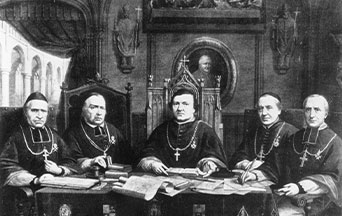
In the second half of the nineteenth century, the Catholic Church in the Netherlands experienced a revival that was at least on par with France and perhaps stronger than anywhere else in the world.
At that time, the Dutch Bishops had the reputation of being Ultramontane, even though they avoided controversies and maintained diplomatic relations with the House of Orange.
Fr. Joseph Witlox described Archbishop Joannes Zwijsen, the first archbishop of Utrecht after the restoration of 1853, as having a remarkably “deep attachment to the Holy See” and “a passionate love for the Pope.”1 This reputation was already earned with his first pastoral letter, published on May 1, 1853:
“We place our trust in the legitimacy of our mission, since we did not seek or desire this difficult ministry, but accepted it with trepidation as obedient sons of the Church… For We possess Our Mission from the legitimate Successor of Saint Peter… to whom the same Redeemer, after His glorious resurrection from the grave, gave the extensive authority to govern His Church and to appoint shepherds over it.”2
Contrary to the Church in France, where the episcopate was heavily divided between Ultramontanes and liberal Catholics, the Dutch Episcopate was united in its obedience to Rome. This was made clear in a letter written by the Dutch bishops to the Propaganda Fidei in 1855:
“When it comes to reverence and veneration of or submission to the Holy See, we are only satisfied with first place.”3
The many pastoral letters they issued in response to the increased assaults of the Risorgimento on the Papal States strongly conformed in tone and substance to their support for the pontificate of Pius IX. In his pastoral letter of February 2, 1860, Archbishop Zwijsen denounced the Risorgimento as a “malicious conspiracy against the authority of the Holy See”, which “especially in these times” would result in “a great disaster for the Catholic Church and her faithful”.4
Bishop Franciscus Jacobus van Vree of Haarlem observed the same in his pastoral letter of February 7, 1860, which also reflected “the unanimous expression of sympathy from all who are Catholic”:
“What deserves special mention in this unanimity, and is also particularly noted by the Holy Father in his encyclical, is the testimony of the bishops dispersed throughout the world that the Roman Pontiff has been given a principality [by Providence], so that, not being subject to any secular power, he might be able to fulfill the obligations of his Apostolic office with complete freedom and without any hindrance throughout the whole world.”5
The submission of the Dutch bishops to the dogmatic encyclical Quanta Cura (1864), along with the Syllabus Errorum (1864) attached to it, was made without reservations and was soon followed by the publication of a Dutch translation.
The dogmatic definition of papal infallibility in Pastor Aeternus (1870) was for them merely a solemn affirmation of what they already held to be true. Due to the uncontroversial nature of their participation, historians such as Cardinal Johannes de Jong and Prof. Ludovicus Jacobus Rogier have, besides listing their names, written little to nothing about the Dutch bishops during the First Vatican Council.6
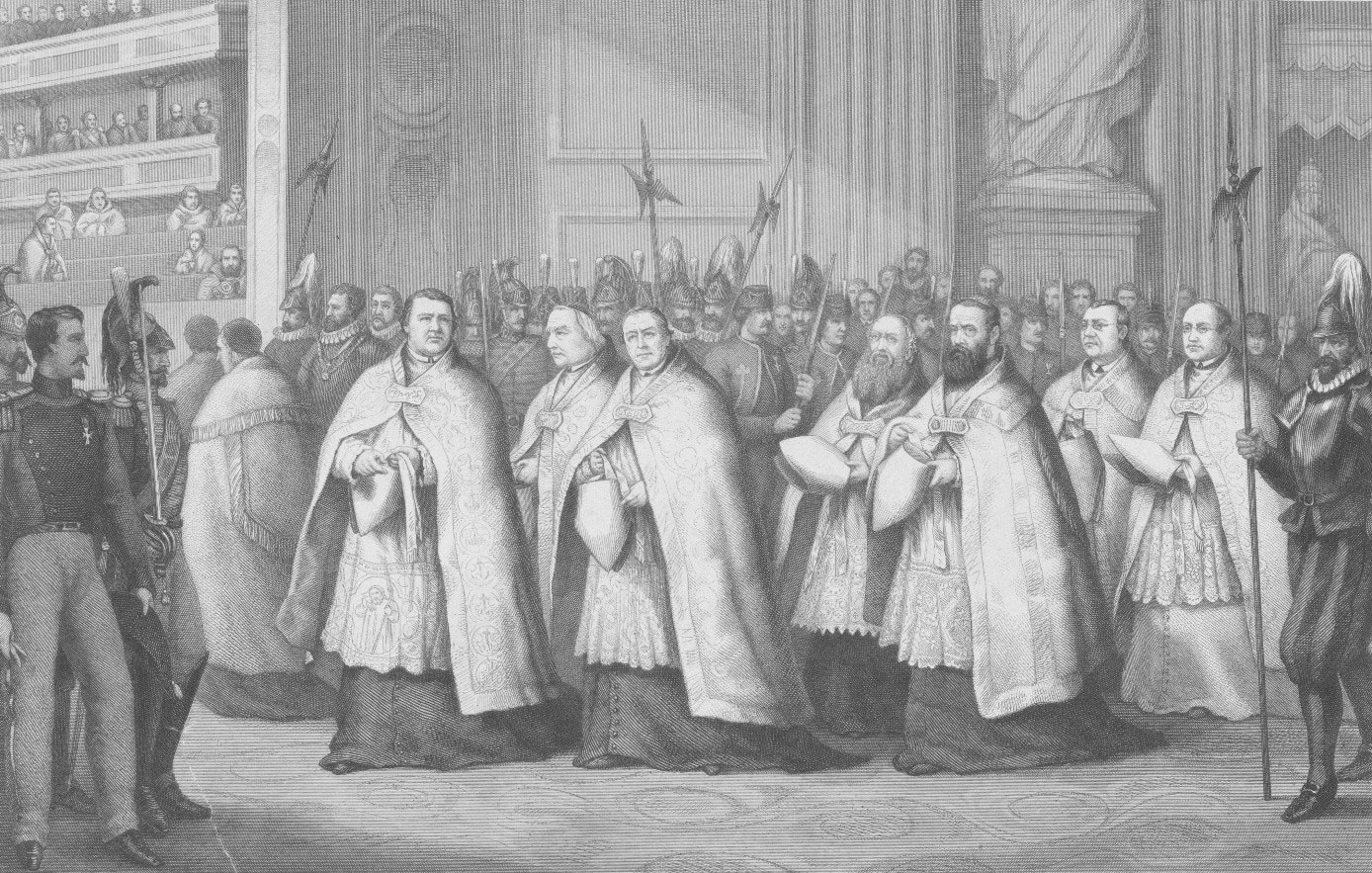
However, despite their obedience to Rome, the relations between the Dutch episcopate and Pius IX did experience some difficulties or tension. Pius IX had canonized 26 Japanese martyrs in 1862, of whom 6 were Franciscans.7 The Franciscan Order wanted to initiate the canonization process of the 19 martyrs of Gorkum killed during the Dutch Revolt, of whom 11 were Franciscans.8
After the restoration of the episcopal hierarchy in 1853, many saw this effort of canonization as yet another sign of the triumph of Catholicism in the Netherlands. However, the Dutch episcopate did not share their enthusiasm. Out of fear that the canonization would lead to the persecution of the Church, they opposed the canonization.
Archbishop Luigi Oreglia di Santo Stefano, the Internuncio of the Netherlands, met to discuss the matter with both Archbishop Zwijsen and Bishop Gerardus Petrus Wilmer of Haarlem. Archbishop Oreglia expressed their concerns about the canonization in a letter written to the Propaganda Fidei on April 18, 1864:
“The martyrs of Gorkum are associated with the expulsion of the Spanish from this empire, the origins of the House of Orange, and the introduction of the Reformation; and since that fact is as glorious for Catholics as it is dishonorable for Protestants, it is obvious that the latter would consider such a solemn act an attack on the honor of the nation and the royal house.”9
Pius IX simply ignored their wishes and went forward with the process. The decree issued by the Sacred Congregation of Rites, which recalled the “satanic wrath” of the Dutch Calvinists, was ratified by the Pope during a Papal consistory on January 6, 1865, while the decree subsequently issued on January 8 called them the “followers of the Calvinist heresy”.10
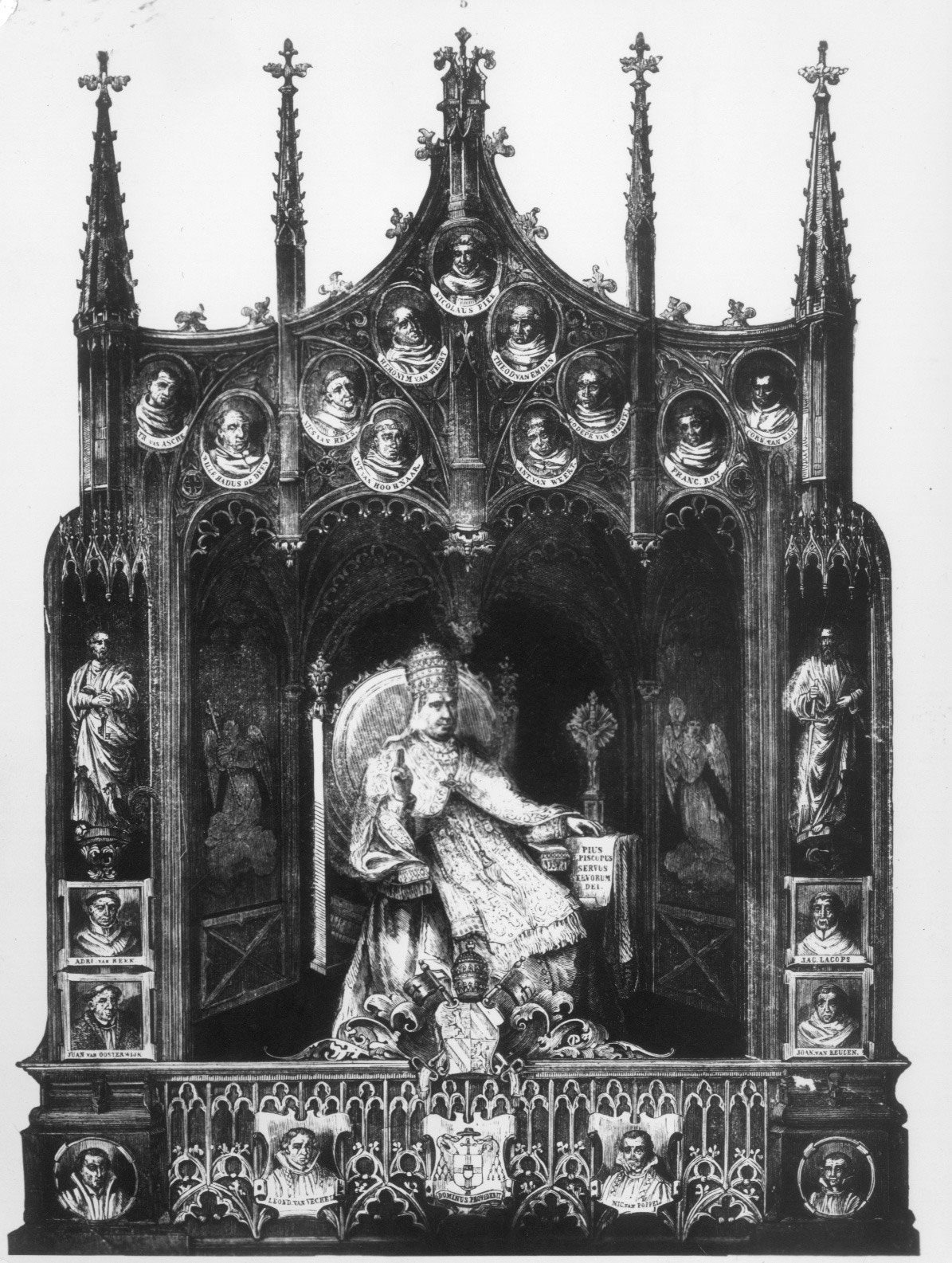
The Dutch Bishops deemed the tone of these documents too strong. Therefore, the decrees of the Sacred Congregation of Rites remained unpublished in the Netherlands. Knowing that the canonization was inevitable, the Dutch Bishops did everything they could to delay the process in order to minimize the reactions in the Netherlands. Due to their efforts, the 19 martyrs of Gorkum were not canonized until June 29, 1867.
Footnotes
- Witlox, J. (1941). Monseigneur Joannes Zwijsen. Den Haag, the Netherlands: Uitgeverij Pax, p. 163-164.
- Zwijsen, J. & Deppen, J. P. (1853, May 3). Herderlijke Brief van Zijne Doorluchtige Hoogwaardigheid Mgr. Joannes Zwijsen, Aartsbisschop van Utrecht. Circulaires (Herderlijke brieven n. 2357). KDC, Nijmegen, the Netherlands. Retrieved from: https://kdc-opac.hosting.ru.nl/details/fullCatalogue/25113.
- De Valk, J. P. (1998). Roomser dan de paus? Nijmegen, the Netherlands: Valkhof Pers, p. 129-130.
- Zwijsen, J. & Jansen, G. M. (1860, February 2). Herderlijke Brief van Zijne Doorluchtige Hoogwaardigheid Mgr. Joannes Zwijsen, Aartsbisschop van Utrecht. Circulaires (Herdelijke brieven n. 42). KDC, Nijmegen, the Netherlands. Retrieved from: https://kdc-opac.hosting.ru.nl/Details/fullCatalogue/22915.
- Van Vree, F. J. & Van Grossel, W. J. (1860, February 7). Herderlijke Brief van Zijne Hoogwaardigheid Franciscus Jacobus van Vree, Bisschop van Haarlem. Circulaires (Herderlijke brieven n. 287). KDC, Nijmegen, the Netherlands. Retrieved from: https://kdc-opac.hosting.ru.nl/details/fullCatalogue/23138.
- De Jong, J. (1949). Handboek der Kerkgeschiedenis IV: De Nieuwste Tijd (1789–1949) (4th ed.). Utrecht - Nijmegen, the Netherlands: Dekker & Van de Vegt, p. 171-176; Rogier, L. J. & De Rooy, N. (1953). In vrijheid herboren. Katholiek Nederland, 1853-1953. Den Haag, the Netherlands: Uitgeverij Pax, p. 137-140.
- Delplace, L. (1910). The Catholic Encyclopedia: Volume IX. New York, the United States: Robert Appleton Company, pp. 744-746.
- Groot, J. C. (1959). Encyclopedie van het Katholicisme. Amsterdam – Elsevier – Brussels, the Netherlands: Winkler Prins Stichting, p. 412.
- De Valk, J. P. (1998). Roomser dan de paus? Nijmegen, the Netherlands: Valkhof Pers, p. 163.
- Ibid., p. 164.