
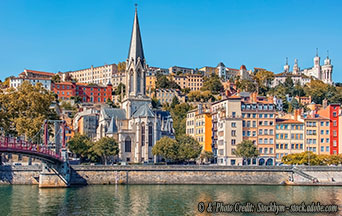
The founder of Lyon’s “Secret,” as its Marian sodality was known, was also its historian, Benoît Coste. He belonged to a wealthy and well-known Catholic family in that city. Born on December 11, 1781, he was still a boy when Lyon, having risen against the French Revolution that had begun in Paris, suffered the horrors of a two-month siege (August 9 to October 9, 1783). Young Benoît starved while witnessing the fighting. He also witnessed the massacre that followed the defeat of that counter-revolutionary reaction. His father, Isaac Coste, one of the combatants, was arrested, tried, and sentenced to death. However, he managed to escape to Geneva, where his family joined him. For fourteen years, the family endured the hardships of exile in various cities in Switzerland and Germany.
Why America Must Reject Isolationism and Its Dangers
In 1797, the installation of the Directory government in Paris seemed to beckon an easing of religious persecution. The Coste family returned to Lyon. Under Napoleon’s leadership, though, their hopes were frustrated. Benoît had the glory of participating in Father Jacques Linsolas’s so-called underground Church. His residence became a refuge for priests who assisted the faithful. Among those who found shelter there was Most Rev. d’Aviau du Bois de Sauzay1, one of the most prestigious members of the French episcopate, recently returned from Switzerland to be closer to his diocese.
Like many young Catholics, Benoît Coste helped the underground Church. He played a leading role in the popular movement demanding the return of places of worship confiscated by the revolutionary authorities under Napoleon’s concordat with the Holy See.
The relative freedom the First Consul granted the Church led Benoît Coste to plan to found a Marian Sodality. Its goal was to gather young Catholics into a more active apostolate. He worked with two of his friends. Despite their experience with Father Linsolas’ imprisonment, their youthful enthusiasm (which often overlooks danger) led them to desire entrance into this important work immediately. However, one consulted a priest, who advised them to postpone the project’s execution. Displeased, Benoît Coste managed to communicate with Father Linsolas in prison. Father Linsolas gave him the same advice.
Eternal and Natural Law: The Foundation of Morals and Law
Obliged to wait, the three friends continued to plan the project. With the utmost caution, they sought out other young people interested in it. They gradually became convinced that they could only accomplish their pious goals if they formed the Sodality secretly. By now, there were seven who could create the initial nucleus. Father Varin, Superior of the Fathers of the Faith, was then in Lyon. The young men asked him to appoint a priest to lead them spiritually. Father Varin indicated Father Pierre Roger, S.J., who was known for his counter-revolutionary ideas.
On July 14, 1802, Coste and his friends determined that:
1. The Sodality’s purpose would be to render glory to God, honor Our Lady, and sanctify its members and neighbors;
2. The Blessed Virgin in her Immaculate Conception would be its patroness;
3. It would be founded on the coming Sunday, July 18.
That Sunday, the seven young men gathered in the chapel of the Fathers of the Faith and solemnly installed the Sodality. In the following days, the members prepared the new association’s regulations. From the start, Father Roger proposed that it be called the Congregation of the Sacred Heart of Mary. The members rejected the proposal because Lyon had always stood out in defense of the Immaculate Conception. Hence, it was more in keeping with tradition to use the title Congregation of the Immaculate Conception. However, they decided to commemorate the Heart of Mary on the Sodality’s anniversary celebrations.
The Sodality’s secrecy prevents a complete description of the functioning of the congregation, its history, and the many benevolent works it accomplished. The decisive help it gave Blessed Pauline Jaricot suffices as a sample of the importance of these works. We can only provide an outline of its vital role in the Catholic resistance against Napoleon, along with its allies, the Paris Congregation and Venerable Father Pio Brunone Lanteri’s Amicizie.
All of Lyon’s sodality members actively participated in this resistance, sparing no sacrifice during the struggle. Two members stood out because of their missions, so we will briefly summarize their lives before entering the Sodality. They were Claude Berthaud Taluyers du Coin and François Franchet d’Esperey.
 Read About the Prophecies of Our Lady of Good Success About Our Times
Claude Berthaud du Coin was born in Lyon on September 8, 1780. His family was noble, owning the castle of Taluyers on the city’s outskirts, where he spent most of his life. To better serve the Church, he did not marry but dedicated himself entirely to the congregation. His mother kept a salon where the Catholic elite of Lyon gathered. Berthaud du Coin attracted youth to it, making it a focal point of early nineteenth-century Catholic culture.
In 1803, he entered the congregation and soon gained a prominent place directing its apostolate. In 1807, he became its vice president and was received into Father Bourdier Delpuits’s2 Congregation on a trip to Paris. The two sodalities were closely united ever since. In a future installment, we will describe the fruits of that union.
François Franchet d’Esperey was born on December 14, 1778. He was wounded in combat against the Revolution just before his fifteenth birthday. He spent many years in Italy and only returned to Lyon in 1802. He joined the “Secret” solidarity two years later. In 1809, he was elected its president. During his presidency, a new conflict between Napoleon and the pope developed. This situation forced counter-revolutionary Catholics to unite to make it possible for the Holy See to exercise the supreme government of the Church.
Footnotes
- Charles François d’Aviau du Bois de Sauzay (1736-1826) was the son of the Count and Countess of Aviau. He was the Archbishop of Vienna from 1790-1801 and then the Archbishop of Bordeaux from 1802 until his death. He spent many of the years of the Revolution in Switzerland so as not to be resident in a country, Austria, at war with his native France.
- Father Jean-Baptiste Bordier-Delpuits, S.J. (1734-1811) founded “The Congregation,” an organization of priests and laypeople in 1801. It disbanded in 1830.