
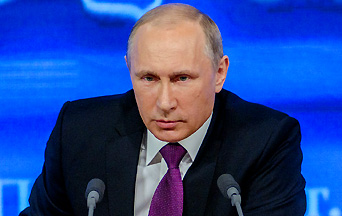
 The Russian invasion of Ukraine has put Vladimir Putin in the spotlight. The attack marks the end of the post-Cold War era, a time when it was thought the Russian threat to the West had ended.
Indeed, the fall of the Iron Curtain left communism in a vulnerable position. It exposed the brutal system in all its poverty and misery, which people naturally rejected. In the post-Cold War era, Russia, still a nuclear power, played a much-diminished role.
However, the Ukraine crisis reveals a newfound vitality emerging from Russia—a resurgence headed by Putin.
The Paradox of Putinism
As the situation in Ukraine intensifies, Putin has not explicitly called for the re-installment of a communist regime. He has, however, summoned the legacy of the fallen Soviet Union, a paradox that veils the Russian president’s intentions.
Putin has expressed a degree of sympathy for the country’s Soviet past. In 2005 and 20181, he explicitly stated his desire to restore the Soviet Union to its former glory. His praise of Josef Stalin, the infamous Soviet dictator during the Second World War, also indicates a degree of affinity between the ideals of the two Russian leaders.2
Eternal and Natural Law: The Foundation of Morals and Law
However, Putin has also condemned communist figures and thought on various occasions. In 2016, he criticized the USSR’s founder Vladamir Lenin, claiming that his model of a federative state “was a time bomb under [the Russian] state.”3
Additionally, in 2017, Putin remarked that he wished that the Bolshevik Revolution of 1917 had never happened.4 Moreover, Putin lauded a “de-communization” effort responsible for the destruction of monuments dedicated to Lenin.5
He has even gone so far as to depict the ongoing invasion of Ukraine as an attack on a remnant of “Bolshevik, Communist Russia.”6
These remarks appear to be in stark contradiction, understandably resulting in widespread confusion. Putin praises Stalin while castigating Lenin. He glorifies the Soviet Union yet condemns its communist and Bolshevik origins. The question naturally ensues: how can such conflicting remarks be reconciled?
Despite all appearances, Putin’s remarks are consistent. A review of the philosophies behind Leninism, Stalinism and Putinism reveals a link with a unifying principle found in Russian nationalism.
Lenin’s Egalitarianism Conflicts with Putin’s Nationalism
Lenin’s rise to power came with the October Revolution of 1917, which deposed the short-lived government of Aleksandr Kerensky. He eventually consolidated his rule by arranging for the murder of the Tsar and his family. The Revolution was followed by the formation of the Soviet Union in 1922, forcibly uniting neighboring countries under a central Bolshevik government.
 Learn All About the Prophecies of Our Lady of Good Success About Our Times
Lenin’s outlook was internationalist and not nationalist. He wrote that “Marxism cannot be reconciled with nationalism” since pure Marxism inevitably works towards egalitarian internationalism.7
He staunchly opposed the “Great-Russian nationalist campaign,” for which he held Stalin responsible.8 Instead, he insisted that Soviet states were at liberty to secede due to what he called their “right to self-determination.”9 He analogized his vision of a utopian society to a “United States of Europe” that would exclude Western capitalism.10
This anti-nationalist position confirms the idea that Leninism and Putinism are irreconcilable. Putin’s own comments about Lenin reinforce this point.11 In 2015, he openly criticized the Bolshevik party, which Lenin founded and led. When referring to Lenin’s desire for Russia to be defeated in World War I to facilitate a social revolution, he accused the party of “[betraying] Russia’s national interests” by “[wishing] to see their fatherland defeated.”12
He also accused Lenin’s 1917 revolution of causing “Russia as a state to collapse and declare itself defeated.”13
10 Razones Por las Cuales el “Matrimonio” Homosexual es Dañino y tiene que Ser Desaprobado
Instead, Putin advocates for Russia’s return to its former glory. The demise of “historical Russia,”14 once a significant world power, has led him to carry out his precarious invasion of Ukraine. By reuniting the “territory of the former Russian empire,”15 he contends, the country will re-achieve the influence it formerly held. He justifies his unjust war in Ukraine under this pretext.
Putin’s Appeal for a Return to the ‘Glory’ of Stalin’s Russia
Thus, while he rejects the action of one communist, he embraces the policies of another. Putin’s previously mentioned tribute to the Soviet Union under Josef Stalin fits with his concept of national greatness. This admiration is no contradiction. His praise was directed less toward the egalitarian Marxist philosophy and more toward his affinity with an authoritarian Russian state.
That is not to say that Putin rejects communist thought altogether. During a 2016 speech, he affirmed, “I really liked and still like communist and socialist ideas.”16
However, these ideas are made to fit into the framework of the supreme, “Holy Russia”17 that he envisions. Russia can be communist as long as she is great.
The Church and the Communist State: The Impossible Coexistence
Thus, Putin utilizes the image of Stalin’s communist Soviet Union to forward his cause. Studies have also shown that Putin’s nationalist narrative has resulted in public nostalgia for the Soviet Russian regime under Josef Stalin. In a recent article, Italian TFP president Julio Loredo noted that Putin has “praised the Stalinist period as one of great glory for Russia.”18 Foreign Policy reported that “President Vladimir Putin has presided over the rehabilitation of one of the twentieth century’s greatest monsters… he has turned to the ghost of Stalin to rally the Russian people and to prepare them for the sacrifices that lie ahead.”19 Statistics also back up this claim, as over half of the Russian population expressed positive sentiments towards the Red dictator.20
However, Putin’s praise of Stalin is that of both an admirer and opportunist. When necessary, Putin has denounced Stalin’s murderous ways as a way to retain a favorable light in public opinion.21
Thus, he appeals to Soviet sentiments remaining in Russia while excluding himself from the controversial past of his predecessors. Putin puts himself in a position that threatens the West like never before.
Different Philosophies, a Common Objective
Putin has formulated a nationalist philosophy in a post-Berlin Wall society that incorporates pan-Slavism, fascism, and socialism while avoiding the stigma of a “communist” label. He attacks Western civilization for its moral decadence rather than resorting to overused Soviet anti-capitalist jargon. The legend of Stalin serves as a tool to recall a past pseudo-greatness.
Science Confirms: Angels Took the House of Our Lady of Nazareth to Loreto
Putinism cannot be equated with Leninism or Stalinism, but all three are united in spreading Revolutionary thought. All three philosophies target the West.
Throughout modern history, the vague remnants of Western Christendom constituted an obstacle to the progress of atheistic revolutionary movements that flourished in the nineteenth and twentieth centuries, often with the help of religious liberals. Today, the postmodern reincarnations of these revolutionary philosophies are attacking the vestiges of this Western Christian order.
The confusing philosophies of Putinism enter into this fight. Although Putin’s beliefs may not entirely coincide with those of Lenin or Stalin, they share a common objective—the destruction of Western, Christian civilization. As a result, Putin’s maneuvers must be opposed.
Footnotes
- See Vladimir Putin, “Annual Address to the Federal Assembly of the Russian Federation,” transcript of speech delivered at the Kremlin, Moscow, Apr. 25, 2005, http://en.kremlin.ru/events/president/transcripts/22931; Reuters Staff, “Putin, before vote, says he’d reverse Soviet collapse if he could: agencies,” Reuters, Mar. 2, 2018, https://www.reuters.com/article/us-russia-election-putin/putin-before-vote-says-hed-reverse-soviet-collapse-if-he-could-agencies-idUSKCN1GE2TF.
- Tony Halpin, “Vladimir Putin praises Stalin for creating a superpower and winning the war,” The Times, Dec. 4, 2009, https://www.thetimes.co.uk/article/vladimir-putin-praises-stalin-for-creating-a-superpower-and-winning-the-war-mz0rjf5sgdl.
- Vladimir Isachenkov, “Putin denounces Soviet founder Lenin,” AP News, Jan. 25, 2016, https://apnews.com/article/7384e0f96dfb41ceaa3724f5c1deae6a.
- Andrew Osborn, “Putin said he wished the 1917 revolution that brought communism had never happened,” Business Insider, Nov. 7, 2017, https://www.businessinsider.com/putin-steers-clear-of-communist-ceremony-steeped-in-russian-history-2017-11.
- TASS Russian News Agency, “Russia ready to show what true de-communization means for Ukraine—Putin,” TASS, Feb. 21, 2022, https://tass.com/politics/1407587?utm_source=google.com&utm_medium=organic&utm_campaign=google.com&utm_referrer=google.com.
- Ibid.
- Lenin, Critical Remarks on the National Question, 1913
- Lenin, The Question of Nationalities or “Autonomisation,” 1922.
- Lenin, The Rights of Nations to Self-Determination, 1914.
- Lenin, On the Slogan for a United States of Europe, 1915.
- Robert Coalson, “Russian Nationalists March On, Under Kremlin’s Wary Gaze,” Radio Free Europe/Radio Liberty, Nov. 3, 2014, https://www.rferl.org/a/russia-nationalist-march/26672137.html.
- Owen Matthews, “Red faces,” The Spectator, Jan. 7, 2017, https://www.spectator.co.uk/article/red-faces
- Ibid.
- RFE/RL journalists, “Putin Laments Soviet Breakup As Demise of ‘Historical Russia,’ Amid Ukraine Fears,” Radio Free Europe/Radio Liberty, Dec. 13, 2021, https://www.rferl.org/a/putin-historical-russia-soviet-breakup-ukraine/31606186.html.
- Keir Giles, Putin’s speech harked back to Russia’s empire—the threat doesn’t stop at Ukraine,” The Guardian, Feb. 22, 2022, https://www.theguardian.com/commentisfree/2022/feb/22/putin-speech-russia-empire-threat-ukraine-moscow.
- INTERFAX.RU, “Putin admitted his sympathy for Bible-consonant communist ideas,” Interfax, Jan. 25, 2016, https://www.interfax.ru/russia/491445.
- Paul Coyer, “Putin’s Holy War And The Disintegration of the ‘Russian World’,” Forbes, Jun. 4, 2015, https://www.forbes.com/sites/paulcoyer/2015/06/04/putins-holy-war-and-the-disintegration-of-the-russian-world/?sh=4852c3d6285b.
- Julio Loredo, “Will the West Let Itself be Squeezed Between Russia and China?,” TFP.org, Jan. 25, 2022, https://tfp.org/will-the-west-let-itself-be-squeezed-between-russia-and-china/.
- Hannah Thoburn, “For Putin, For Stalin,” Foreign Policy, Jan. 25, 2016, https://foreignpolicy.com/2016/01/25/for-putin-for-stalin-russia-propaganda.
- David Masci, “In Russia, nostaligia for Soviet Union and positive feelings about Stalin,” Pew Research Center, Jun. 29, 2017, https://www.pewresearch.org/fact-tank/2017/06/29/in-russia-nostalgia-for-soviet-union-and-positive-feelings-about-stalin/.
- Vladimir Isachenkov, “Russia’s Putin condemns Soviet-era political repressions,” AP News, Oct. 30, 2017, https://apnews.com/article/e708f321bd83433395d77755fa6651db.