
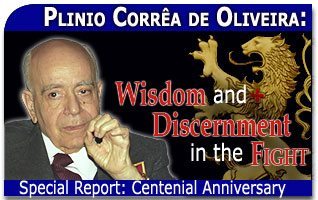
Writing about Professor Corrêa de Oliveira is not easy. He led such a rich and multifaceted life that an author easily becomes overwhelmed, as would a marine biologist asked to write an article about the ocean. Where would he start? What would he cover? How detailed would he be?On the other hand, if the same biologist were able to take a more fundamental approach, and show the framework from which to understand the ocean properly, he would have accomplished more than he would have by developing a single aspect of the sea, because he would have furnished his readers with the elements to study the ocean on their own and hopefully motivated them to do so.
This is the task this article sets out to accomplish. If successful, it will demonstrate how one should approach the writings of this fearless Catholic leader and instill an ardent desire to learn more about this man, aptly dubbed: “the crusader of the twentieth century.”
To understand Professor Corrêa de Oliveira, one must first realize that the guiding force of his life was grace. The gifts of the Holy Spirit, especially wisdom, were well established in his soul. Years of submission to God’s grace gave him a wisdom that surpassed his physical intelligence.
Thus, he understood world events so profoundly that, at times, he was able to predict how these events would unfold in the future. Applied to his actions, wisdom gave him a sense of where the most critical weaknesses in the Church’s enemies were and the knowledge to exploit these weaknesses to the fullest extent.
Exemplifying these abilities will show how wisdom influenced Professor Corrêa de Oliveira’s life, give the proper framework from which to study him and inspire more interest in him.
Part 1
Foresight
Professor Corrêa de Oliveira demonstrated his ability to foresee what the future held on many occasions. This was recognized even by some of his staunchest enemies. For example, liberation theologian Father João Libânio said to a newspaper in the Brazilian city of Curitiba in 1996:
Plinio Corrêa de Oliveira gave a lecture to the Jesuits in 1940 in which he espoused a messianic idea, saying that the great problem of Christianity would be Islam. That was 50 years ago. It was prophetic, or history followed that path for other reasons. Either way, events have confirmed his prediction.1
There was nothing directly mystical about his foresight. Rather, Professor Corrêa de Oliveira was gifted with that “daring and unique finesse of observation and analysis which enables some men to foresee tomorrow.”2
This sprang from his ability to see in seemingly disjointed and sometimes chaotic world events, coherent forces of good and evil locked in the unending struggle God predicted when He cursed the serpent in Paradise, saying: “I will put enmities between thee and the woman, and thy seed and her seed. She shall crush thy head, and thou shalt lie in wait for her heel” (Gen 3:15).
Thus, he saw how current events fit into an understandable reality3 like pieces of a jigsaw puzzle, which, when put together revealed a bird’s eye perspective. From this viewpoint, he was able to conjecture about the future, and history has shown how accurate he could be.
Resurgence of Islam
After World War I, the Ottoman Empire was partitioned, and England and France assumed control of its Arab Muslim territories. The power of the crescent moon seemed broken forever.
The discovery of oil in the region, shortly before the war, gave the western world a vested interest in the area. Colonial expansion made the resurgence of Islam even less likely.
However, Professor Corrêa de Oliveira thought differently. Throughout the forties, he repeatedly warned that radical Muslims would once again rise to threaten the West. In August 1943, he commented on proposals to form a coalition of Arab unity (that ultimately culminated in the Pact of the Arab League States in 1945) in the following way:
The disunity of Islam was one of the great reasons for its decadence. The meeting of the Arab States will mean the constitution of another vast political and ideological block that is both eastern and anti-Catholic.4
Again in December of the same year, he warned:
The Muslim peril is immense. The West seems to have shut its eyes [to this threat]…. With money, men and weapons, anything can be done these days. The Muslim world possesses all the men and money they need. Weapons will not be difficult for them to obtain…and with this, they will become an immense power throughout the West.5
Recent developments in the Middle East, including the possible rise of a nuclear Iran, show the accuracy of this prediction.Similarly, the current oil crisis makes painfully clear the accuracy of the following affirmation Professor Corrêa de Oliveira made in October 1944:
The Muslim world has natural resources that are indispensable to Europe. She will have in her hand the necessary means to disturb or paralyze, at any moment, the rhythm of the entire European economy.6
The war on terror in Iraq and Afghanistan supports this 1946 statement:
Before long, international issues will arise. There will be difficulties with neo-Islamism that will brandish machine guns against a divided, anarchic and exhausted West.7
In 1947 he showed himself not to be an alarmist, but a realist, when he stated:
The Muslim problem…is still not entirely an issue of today; it is already indisputably a grave problem of tomorrow.8
World War II
Perhaps Professor Corrêa de Oliveira’s most accurate predictions were made in the years preceding the Second World War. He not only foresaw that war was unavoidable, but gave detailed analyses of how certain events would unfold.
These predictions began in 1935, two years before Neville Chamberlain became British prime minister and three years before he returned from Munich to announce to cheering crowds his ill-fated appeasement agreement with Hitler.
In October 1935, Professor Corrêa de Oliveira described the world as being “faced with a universal war.”9 He returned to the theme in November 1936, saying: “In a little while…an international deluge will come: world war is knocking at the door of Western civilization.”10
Professor Corrêa de Oliveira continued his warnings throughout the thirties. Shortly before the September 30 Munich agreement, the Catholic leader wrote:
Everything leads us to believe that if the specter of war will be imminently extinguished by the meeting of Hitler and Chamberlain, conflict will not be truly avoided, but merely put off…. War will come in a question of days or months, but inevitably it will break out…. As long as Hitler is in power it is unavoidable.11
Once the buildup to war had begun, Professor Corrêa de Oliveira perceived that Soviet Russia and Nazi Germany were moving ever closer to a dangerous union. He based this on his belief that Nazism and Communism were but two faces of the same evil.12
Since the public considered them to be vicious enemies, it must have shocked many of his readers when in January 1939 he wrote:
While all the battlefields are being marked out, an increasingly clear process is taking place: that of the doctrinal fusion between Nazism and Communism. In our opinion, the year 1939 will see the achievement of this fusion.13
When six months later, the Soviets and Nazis signed the Ribbentrop-Molotov Pact, the world was astounded by what historian and biographer Roberto de Mattei calls “the most unexpected ‘reversal of alliances’ of our time.”14
Although presented as a simple nonaggression pact, the agreement secretly divided Central Europe between Nazi Germany and Soviet Russia. Although this was not made public for years, Professor Corrêa de Oliveira perceived that there was more to the alliance than met the eye. A little more than a month later, when the Soviets and Nazis invaded Poland, he wrote:
Everything leads us to believe that war was decided on, not by a simple nonaggression pact, but by a secret accord between Russia and the Reich, from which will probably result the partition of Poland.15
This was confirmed when Poland was brutally split between the two regimes.
However, Professor Corrêa de Oliveira was not convinced that the Soviet-Nazi alliance would endure throughout the war. The day after the pact was signed, he wrote: “The Russian-German alliance was a clumsy act. It is possible that within a short time Hitler and Stalin will return to being enemies.”16
For the next two years, the alliance seemed to strengthen. Nevertheless, Professor Corrêa de Oliveira refused to abandon his prediction:
As everyone can see, the Russian-German collaboration is reaching its peak…. But just now, when this collaboration seems to have reached its height, we dare to add for our readers something that will surely surprise them: at the point at which these relations now stand, it is possible that they will last for a long time, just as it is possible that Germany could suddenly attack Russia…. Whoever lives will see.17
A month later, on June 22, 1941, the Germans broke the agreement by invading Russia in Operation Barbarossa.
European Union
Today, the European Union’s anti-Catholic bent is well known. This was made patent by its refusal to mention Europe’s Christian heritage in its draft constitution and its promotion of contraception, abortion, embryonic stem-cell research, same-sex “marriage,” and other aberrations.
It is similarly easy to see the damage the EU is doing to European culture. In France, this came into focus when it tried to force the country to pasteurize the milk used to make cheese, which would have fatally damaged its flavor and texture. Similarly, it has attempted to heavily tax alcohol, fundamental to the cuisine of almost every European nation.
It is also evident that currency standardization and lax borders are contributing to a failing sense of national sovereignty and identity.
But would these problems have been easy to see twenty or thirty years ago?
Professor Corrêa de Oliveira foresaw them more than fifty years ago, when a supranational European entity was first being discussed. His opinions were controversial at the time. That did not prevent him from expressing his concern. He did so especially in two articles he wrote in the early fifties.
The first was published in the new publication begun under the TFP founder’s leadership, Catolicismo. In it, he stated:
One of the most important dates in this century is, without a doubt, that of the meeting in Paris, in which representatives of France, Italy, West Germany and the little powers that make up Benelux—Belgium, Holland and Luxembourg—decided, in principle, to construct a European Federation, through the formation of one international governmental entity, and consequently a common authority, to grow as a superstructure, over the various national governments.
Inflamed with a love of history, Professor Corrêa de Oliveira was horrified:
As you can see, we are dealing with an immense happening. Nations that have filled History with the irradiation of their glory will disappear…and a new federal state will arise, whose future is difficult to foresee.18
That is not to say that Professor Corrêa de Oliveira opposed any type of international governing body. Indeed the Holy Roman Empire, founded by Charlemagne, was perhaps the institution he loved most throughout history, after the Church Herself.
However, as he explained in the same article, legitimate international bodies must be constituted for a licit and well-established end. Once they begin to exercise too centralizing a role, they become an aberration.
He further developed this thought in a 1952 article:
Each nation can and should remain alive and defined, within the supranational structure. It must maintain its borders, territory, government, language, customs and law. It must retain its own national character…. [Opposing this reality] is certainly not acting according to the designs of God, Who created a natural order, in which the nation is an indestructible reality.… [Any international body] should be the protector of national independence, not a nation-devouring hydra.
He particularly feared the secular nature he felt such a federation would adopt and the consequences this would have for the Church:
If the European federation places itself under the shadow of the Church, it will be inspired, animated and vivified by Her. What of it then could not be hoped for? However, if it ignores the Mystical Body of Christ, what can be hoped for from it?19
It is easy to see which path the European Union has taken.
Communism
In 1989, public assessment of hard-line communism as a future threat fell with the Iron Curtain. Public opinion, filled with dreams of a peaceful, nuclear-free future, suppressed the Cold War from its memory like a tragic experience from childhood.
Professor Corrêa de Oliveira made a much more sober assessment of the facts. This is not surprising, since he had clearly predicted the dissolution of Communism for more than a decade. He had also opined that this would not represent the death of the anti-Catholic ideology, but merely its metamorphosis into another variation of evil, based on the same moral errors of pride and liberalism.
He expressed this belief in a 1976 addition to his seminal work, Revolution and Counter-Revolution:
The panorama presented here would be incomplete were we to fail to mention an internal transformation in the Third Revolution [communism]. It is the Fourth Revolution [the cultural and sexual revolutions] that is being born of it.
It is being born, yes, in the manner of a matricidal refinement…. Everything indicates that the Third Revolution has now arrived at the moment, at once culminating and fatal, when it generates the Fourth Revolution and thus exposes itself to being killed by it.20
Immediately after the Berlin Wall fell in 1989 and the demise of Soviet imperialism seemed certain, Professor Corrêa de Oliveira wrote the manifesto Has Communism Died? And What About Anti-Communism? In it he warned against the “optimists,” who felt the world would enter
an era of perfect concord and eternal peace for a world finally liberated from the great structures. To this end, many…aspire to the fusion of all nations, all philosophical and religious schools of thought, and all ideologies, no matter how mutually conflicting they might be…. Thus, total disarmament would no longer appear reckless and instead become alluring.
He did not believe that the Soviet threat was over.21 Putin’s invasion of Georgia, his threats to Ukraine and former Soviet border states and his attempts to bring back the country’s “past glory” by reintroducing the melody of the Soviet anthem and the Communist star show how right Professor Corrêa de Oliveira was.
Responding to those who believed the newly freed Soviet population, filled with initiative, would build a new world by themselves, he wrote:
Such could actually be the attitude of a people subjected to prolonged misery. However, it is also plausible that a people treated thus could instead feel crushed, discouraged and accustomed to the dismal life of slavery.22
Considering that one in eight deaths in Russia is caused by alcohol-related illnesses and the population is disappearing at a rate of 700,000 people annually,23 it is clear that Russia did not resurrect from its Communist depression and remains “crushed and discouraged.”
Part 2
Discernment in the Fight
Professor Corrêa de Oliveira was, above all, a Catholic fighter. Among others, two scholars recognized this. Both Lizanias de Souza Lima and Professor Roberto de Mattei titled their biographies of Professor Corrêa de Oliveira: The Crusader of the Twentieth Century.Since the struggle against evil held a central role in his life, Providence furnished him with special abilities to fulfill this task. Among these was the ability to sense the Achilles’ heel in the Church’s adversaries, and then exploit that weakness to the fullest extent.
Oftentimes, this led him to take actions that some thought misplaced. To some, he must have seemed like the fabled Don Quixote, chasing after windmills. However, history has shown that the “windmills” he fought were often watershed issues in which his actions were vital.
Progressivism
A perfect example is the position Professor Corrêa de Oliveira took in face of nascent progressivism.
In 1935, the bishops of Brazil founded Brazilian Catholic Action in response to a call by Pope Pius XI to enlist the help of the laity in the hierarchy’s apostolate. Shortly thereafter, Professor Corrêa de Oliveira became president of Catholic Action in São Paulo.
In this position, he saw that strange new doctrines were being disseminated throughout the movement. In his article “Plinio Corrêa de Oliveira: His Early Years,” John Blain explained: “Plinio’s growing apprehension resulted from his certainty that the crisis within Catholic Action was not only local but worldwide and could become the heresy of the century.”24
In 1943, Professor Corrêa de Oliveira reacted by publishing In Defense of Catholic Action,25 which denounced these errors and made him an outcast for almost a decade. Many saw the book as a “deplorable assertion by a narrow and backward mind, attached to erroneous doctrines and prone to imagining nonexistent problems.”26
However, that Professor de Oliveira was right is proved by the persistence of the errors he denounced. Progressivism truly became the “heresy of the twentieth century,” and the young Catholic leader was in the center of the struggle against it from the beginning.
Some of the errors he denounced in his 1943 book were the weakening of the distinction between clergy and laity; attitudes of open dissent with Catholic doctrine among the faithful; denying that original sin inclines man to evil; denial of the dangers of occasions of sin, leading to the acceptance of improper fashions; an exaggerated notion of solidarity that deemphasized everything that differentiates men, such as nationality and religion; and improper lay involvement in liturgical ceremonies.
The persistence of these errors after sixty years demonstrates first, that progressivism did become a major movement and second, the effectiveness of the efforts in which Professor Corrêa de Oliveira took part, since these errors are still controversial after sixty years of leftist promotion.
Mitterrand’s Self-Managing Socialism
In 1981, the socialist François Mitterrand became president of France. He brought with him an agenda of decentralization that was promoted as a balance between Soviet-style Communism and capitalism. It was a program that he called “self-management.”
Professor Corrêa de Oliveira immediately perceived that, more than just a new flavor of leftism, this plan was a basket into which worldwide socialism was sticking all of its eggs. His criticism of the new system took the form of a manifesto titled: What Does Self-Managing Socialism Mean for Communism: A Barrier? Or a Bridgehead?27
The manifesto was published as a six-page advertisement in forty-seven newspapers in nineteen countries. The scope of the manifesto was later extended when a one-page summary of its message was published in scores of other publications worldwide in forty-nine countries in thirteen languages. Repercussions came from 114 countries. Little-known details of self-management came to light and widespread public debate ensued.
Professor Corrêa de Oliveira showed how the new program was a refinement of Communism, whereby the all-powerful state would be replaced by smaller socialistic systems whose local groups would exercise a much tighter control of citizens.
As American TFP Vice-president John Horvat wrote in the article “Recalling French Self-Managing Socialism 25 Years Later,”
The new French Socialism hoped to apply gradually their self-managing reforms not only to the economy but the very structure and functioning of the family, schools, the arts and all aspects of social life. The program even extended into the personal lives of citizens by seeking to organize leisure and interior decoration of houses.28
In the end, the program was a colossal failure. Since self-management was socialism’s hope for the future, the consequences of its demise were devastating to the left.
This was admitted by John Vinocur in a New York Times article: “[The fall of self-management meant] the failure of a method, the abandonment of an economic theory and a crisis of the myth and ideology that dominated French intellectual life for nearly 100 years.”29
Understandably, journalist Daniel Singer wondered if Mitterrand’s place would be remembered “as the unifier of the French left or as the destroyer of its dreams.”30
The Soviet Breakup
After the fall of the Berlin Wall, while the world wondered what would become of the Soviet empire, Professor Corrêa de Oliveira was setting his sights on Soviet leader Mikhail Gorbachev, desperately trying to hold that empire together.
When Lithuania, Estonia and Latvia declared their independence, the Soviet leader attempted to delay their freedom for two years.
Professor Corrêa de Oliveira saw in this act the weak point he had been waiting for and acted. Since Gorbachev prided himself in having the support of world public opinion, Professor Corrêa de Oliveira launched a worldwide petition drive in support of the freedom of Lithuania.
The petition, addressed to Lithuanian president Vytautas Landsbergis, expressed support for his courageous proclamation of national independence. It read in part:
As the uncertainty of the international scene threatens your reborn hopes, we wholeheartedly participate in your anguish. We raise a cry of indignation and protest—of protest against any political arrangement that would delay putting into effect the glorious declaration proclaiming Lithuania a free and independent country proudly assuming its place in the family of nations.
In four months, members of the TFP associations around the world personally collected 5,218,520 signatures, in what the 1993 Guinness Book of World Records termed the largest verifiable petition drive in history.
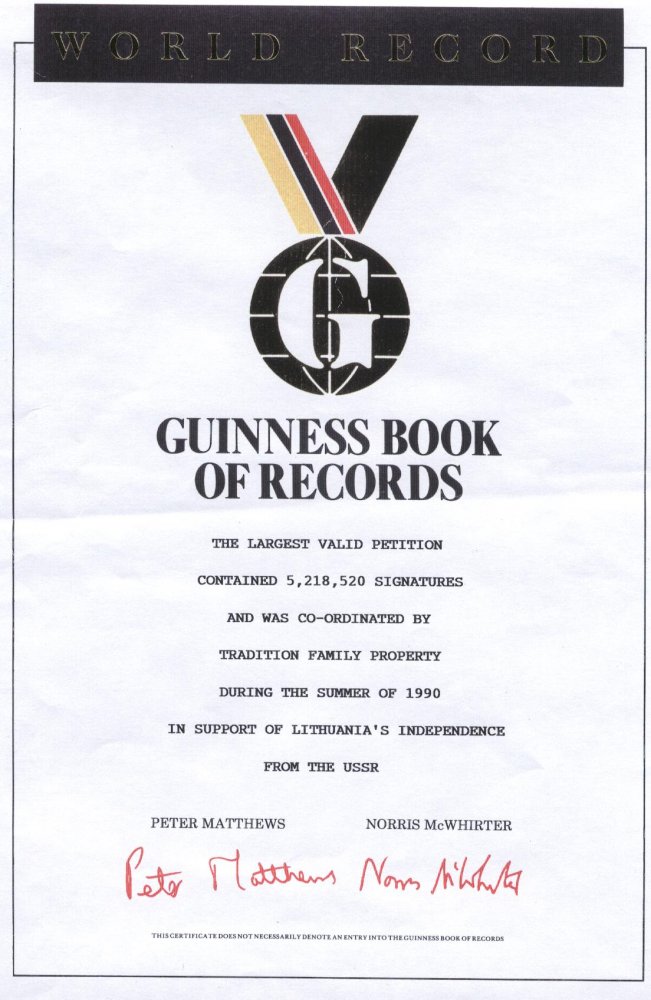
The signatures were delivered by a TFP delegation to President Landsbergis in Vilnius and Gorbachev was given a copy of them in Moscow.
Lithuania gained its independence, and the last Red Army troops left the country in August of 1993. Gorbachev lost the international prestige he had worked so hard to secure. A front-page article of The New York Times later reported:
Vigorous, opinionated and deeply frustrated, the last Communist leader of the Soviet Union floats across the political landscape like a restless ghost, unable to make his presence felt.
Mikhail S. Gorbachev’s name is not even mentioned in most surveys of voter’s favorite politicians…. Sometimes he is vilified, but mostly he is ignored.31
In 1998, the former Soviet ruler explained the ultimate reason for his loss of prestige and the failure of his plans, in a conversation with Giulio Andreotti, former Italian prime minister and writer for 30 Days magazine. Gorbachev told Andreotti:
The Baltic countries were to regain their sovereignty only at the last and the insistence on that as a priority that could not be postponed put the whole plan for the construction of acceptable “renewal” [of the Soviet Union] into crisis.32
Conclusion
The above examples from the life of Professor Plinio Corrêa de Oliveira lead to three conclusions.
First, thirteen years after the Catholic leader’s death, his works are as timely as ever. This is so not only because of the principles of wisdom that can be drawn from them, but also because of his singular ability to speak authoritatively about events that are still unfolding today.
Second, those discouraged by the weight of a world that has turned its back on God should take courage. Realizing that Divine Providence raised up such a man as Plinio Corrêa de Oliveira and blessed him with the wisdom necessary to effect real change in favor of the Church and Christian civilization shows that God has not abandoned society. An old saying states that graces hold within themselves the promise of future graces. The life of Plinio Corrêa de Oliveira is a pledge that God will continue to give graces so that the Church will triumph over the errors of contemporary society.
Last, it should inspire further study of Plinio Corrêa de Oliveira. Individually, each of these examples is impressive, but, taken as a whole they strongly suggest a wisdom and knowledge that go beyond nature. They reveal a man whose life was inspired by God’s grace. Thus, a study of Professor Corrêa de Oliveira and his works is a study of the realization of a plan of God in the life of a man.
That is why those who knew Plinio Corrêa de Oliveira wish to honor him on this hundredth anniversary of his birth. They will never cease to feel a profound loss at his death, but also thank God that such a man ever lived.
For research, the author relied heavily on Juan Gonzalo Larrain Campbell’s Plinio Corrêa de Oliveira: Previsões e Denúncias em Defesa da Igreja e da Civilização Cristã.
More on Plinio Corrêa de Oliveira
- His Life: Who Was Plinio Corrêa de Oliveira?
- His Formation: The Early Years
- His Character: A Man of Faith and Action
- His Foresight: Wisdom and Discernment in the Fight
- His Thought: Philosophical Self-Portrait
- His Masterwork: Revolution and Counter-Revolution
- His Mission: What Is the Counter-Revolution?
- TFP Books and Publications
Footnotes
- Jornal Indústria & Comércia, Curitiba, Aug. 26-27, 1996, B-2 and B-4.
- Plinio Corrêa de Oliveira, Revolution and Counter-Revolution (The American Society for the Defense of Tradition, Family and Property, Spring Grove, Penn., 2003), 161. Also available at www.tfp.org/tfp-home/books/revolution-and-counter-revolution-v15-1370.html.
- To better understand Professor de Oliveira’s beliefs on the unity of the crises affecting modern society, see Plinio Corrêa de Oliveira, Revolution and Counter-Revolution.
- Plinio Corrêa de Oliveira, “Neopaganismo,” Legionario, Aug. 8, 1943.
- Plinio Corrêa de Oliveira, “A Questão Libanesa,” Legionario, Dec. 5, 1943.
- Plinio Corrêa de Oliveira, “Sete Dias em Revista,” Legionario, Nov. 8, 1944.
- Plinio Corrêa de Oliveira, “Sete Dias em Revista,” Legionario, July 21, 1946.
- Plinio Corrêa de Oliveira, “Sete Dias em Revista,” Legionario, Oct. 19, 1947.
- Plinio Corrêa de Oliveira, “Self-Control,” Legionario, Oct. 13, 1935.
- Plinio Corrêa de Oliveira, “Unidade Nacional,” Legionario, Nov. 22, 1936.
- Plinio Corrêa de Oliveira, “O Verdadeiro Sentido do Vôo de Chamberlain,” Legionario, Sept. 18, 1938.
- Professor Plinio describes his views on the links between Communism and Fascism in the article “Is it Fascist to be Anti-Communist?” www.tfp.org/tfp-home/statements/is-it-fascist-to-be-anti-communist.html.
- Plinio Corrêa de Oliveira, “Entre o passado e o futuro,” Legionario, Jan. 4, 1939.
- Roberto de Mattei, The Crusader of the Twentieth Century: Plinio Corrêa de Oliveira (Cromwell Press, Wiltshire, 1998), 57.
- Plinio Corrêa de Oliveira, “Nota Internacional,” Legionario, Sept. 3, 1939.
- Plinio Corrêa de Oliveira, “Anti Komitern!,” Legionario, Aug. 7, 1939.
- Plinio Corrêa de Oliveira, “Sete Dias em Revista,” Legionario, May 18, 1941.
- Plinio Corrêa de Oliveira, “O Culto Cego do Número na Sociedade Contemporânea,” Catolicismo, Aug. 8, 1951.
- Plinio Corrêa de Oliveira, Catolicismo, Feb. 1952.
- Plinio Corrêa de Oliveira, Revolution and Counter-Revolution, 156. Also available at https://tfp.org/tfp-home/books/revolution-and-counter-revolution-v15-1370.html.
- See Has Communism Died? And What About Anti-Communism? Available at: www.tfp.org/tfp-home/statements/has-communism-died-and-what-about-anticommunism.html
- www.tfp.org/tfp-home/statements/has-communism-died-and-what-about-anticommunism.html.
- Tony Halpin, “Health alert as Russia’s alcohol consumption triples,” www.timesonline.co.uk/tol/news/uk/health/article1647475.ece.
- John Blain, “Plinio Corrêa de Oliveira: His Early Years,” www.tfp.org/tfp-home/plinio-correa-de-oliveira/plinio-correa-de-oliveira-his-early-years.html
- Copies of In Defense of Catholic Action can be purchased by calling (888)317-5571.
- Eloi de Magalhães Taveiro, “Passing the Test of Time,” Catolicismo, June 1963, also published as the preface to Plinio Corrêa de Oliveira’s In Defense of Catholic Action (The American Society for the Defense of Tradition, Family and Property, Spring Grove, Penn., 2006).
- Plinio Corrêa de Oliveira, The Double Game of French Socialism: Gradual in Strategy, Radical in Goal—What Does Self-Managing Socialism Mean for Communism: A Barrier? Or a Bridgehead? www.tfp.org/tfp-home/books/the-double-game-of-french-socialism-gradual-in-strategy-radical-in-goal.html.
- John Horvat II, “Recalling French Self-Managing Socialism 25 Years Later,” www.tfp.org/tfp-home/news-commentary/recalling-french-self-managing-socialism-25-years-later.html.
- John Vinocur, “France’s Leftist Leaders Veer From Chartered Path,” The New York Times, Dec. 24, 1983, 1.
- Daniel Singer, “Mitterrand’s Legacy,” Jan. 29, 1996, www.thenation.com/doc/19960129/singer.
- Alessandra Stanley, “Gorbachev’s New Battle: Overcoming His Legacy,” The New York Times, Mar. 10, 1995.
- Guilio Andreotti, “One Evening at Dinner with Gorbachev…,” 30 Days, no. 10, 1998.